Trendy winter hairstyles are the cuts, colors, and styles that solve the specific problems cold weather creates for your hair. The difference between a winter style and a year-round one usually comes down to how it behaves under a coat collar, a beanie, or dry indoor air. A chin-length bob, for instance, lands clear of scarf knots so you are not fighting bulk at the neck every time you step outside.
Chin-Length Bob

A chin-length bob sits right at the jawline, not above it where it turns into a flapper crop and not below where it starts reading as a grown-out lob. That specific placement matters for winter because the clean line falls clear of most coat collars and scarf knots, so you are not fighting bulk at the neck every time you step outside.
Minimal layering keeps the shape intentional even when you air-dry it. I have seen this cut go wrong when someone asks for texture and ends up with wispy ends that flip out in damp weather; the winter version works better blunt, letting the weight do the styling. It flatters most face shapes because the jawline acts like a frame you already own, though if your hair is wavy, curly, or coily, ask for the cut on dry hair so your stylist accounts for shrinkage before the scissors come out.
Curly Crop

A curly crop that hits mid-neck with lots of layers gives curls the movement they need without falling into that dreaded triangular shape winter humidity can create. The layers distribute volume so the silhouette stays rounded through the crown and tapered toward the ends, rather than widening at the bottom like a triangle.
Shorter length matters more than you’d think in cold months. Wet hair in winter means longer exposure to low humidity, which pulls moisture from the shaft and leaves curls dry and brittle. A mid-neck crop cuts drying time significantly, whether you’re diffusing or air-drying, so you’re not walking into freezing air with damp hair that will contract and expand as temperatures shift.
You can work with natural texture or build the shape with mousse and a diffuser. Hot rollers on dry hair also create that bouncy, defined curl if your hair needs help holding the pattern. The cut grows out gracefully too, so you won’t be back in the chair every six weeks.
Micro Bangs

Micro bangs sit a full inch or more above the brow line, which changes how they behave under a beanie or beret. The short length means the hat band presses against your forehead above the fringe rather than flattening it, so you pull the hat off and the bangs still hold their shape. Less hair on the face also means less trapped heat against your skin during a brisk walk, so grease buildup through the day stays minimal compared to heavier styles.
The cut reads deliberate rather than accidental only on certain bone structures. What convinced me, reading through a dozen of these breakdowns, is that oval and heart-shaped faces carry the look without it seeming like costume or cosplay. Rounder faces tend to need the vertical balance of longer bangs; the micro length emphasizes width instead of correcting it. Square jaws can work if the bangs are piecey and feathered at the edges, softening the hard line rather than drawing a second one across the forehead.
Flippy Bob

Blunt ends that flip outward rather than curling under give the flippy bob its throwback energy, and that upward kick happens to solve a winter problem most of us don’t think about until we’re dressed. A heavy turtleneck or a structured wool coat creates a lot of visual weight at the shoulders and neckline. Hair that turns under at the jawline competes with that bulk; ends that flick away from the face create separation and keep the whole silhouette from feeling swallowed.
The cut sits mid-neck with minimal layers at the bottom, sometimes paired with curtain bangs. That length and the blunt perimeter are what let the flip hold its shape through the day. Oval, heart, and square face shapes tend to carry it well, since those soft outward edges balance sharper features rather than hugging them.
Heat styling is minimal once the shape is in. A flat iron bent upward at the ends, or a large curling iron or heated round brush used on the bottom sections, does the work in minutes. Hairspray locks it in. The real advantage is that the flip is forgiving; second-day hair often falls into a softer version that still reads intentional, which matters when morning light comes late and leaving the house fast is the goal.
Mid-Length Chop

A blunt cut landing between the collarbone and shoulder has quietly replaced the long-hair default for women who want change without the drama of a pixie or the maintenance of extensions. Stylists in Chicago and New York both note this length works across textures and gives fine hair the illusion of thickness when the line is kept sharp.
The practical win shows up the second you zip a coat. Hair this length sits cleanly under wool and down without tangling at the ends in scarf friction, which is why the midlength chop keeps surfacing as the answer to winter’s specific aggravations. It is long enough to curl or braid on the weekends, short enough to avoid the maintenance spiral.
Hailey Bieber’s off-duty lob from early 2026, hitting right at the collarbone with softened rather than razor-sharp edges, pushed this cut from backup plan to main event. For a similar effect, ask for one length just above the bust line, or add longer face-framing pieces if a strict blunt line feels too severe. Blow-dry the front for volume, let the rest air-dry, and finish with texture spray.
Clavicle Cut

The clavicle bone itself is the only ruler you need when asking for this cut. Landing right at that horizontal ridge gives you a length that lifts away from heavy turtlenecks and mock-necks instead of fighting them, which is why it reads as a winter style even though the cut works year-round.
What convinced me, reading through a dozen salon accounts of this length, is how the bone acts as a fixed landmark. Hairdressers see inches differently than clients do; one person’s "shoulder length" sits at another person’s jaw. The clavicle is unambiguous. You can feel it, point to it, and know exactly where the ends will fall when dry.
That specific drop creates a natural frame against high-neck knits. The hair skims the fabric line rather than disappearing into it or ballooning above it, so the face keeps its shape even when you’re swaddled in cashmere or chunky wool. I’ve noticed in photos of this cut that the slight curve of the ends follows the same arc as a crewneck or folded turtleneck, which makes the whole neck area look intentional rather than accidental.
Mid-Length Blunt Lob

A blunt lob that hits between the collarbone and the shoulders carries enough weight at the perimeter to do something layered cuts cannot: the solid edge acts like a barrier against winter static, pressing flyaways down rather than letting them lift where heat and dry air create them. The density of the line means each strand has neighboring strands holding it in place, which is why this cut shows up in salon requests every January right after the worst of the dry indoor season hits.
The same weight that tames static creates a styling divide. Blown out with a round brush, the blunt edge reads as expensive and intentional, the kind of polished that works for an office or a dinner where you want to look like you tried. Left to air-dry, the same density works against you; any unevenness in texture or wave pattern sits right on the surface with no layers to break it up, and the perimeter can dry with a slight flip or bend that looks accidental rather than styled. For anyone who skips the blow-dryer most mornings, this is the trade to weigh before committing to the scissors.
Ethereal Waves

Dry indoor air does the styling work for you with ethereal waves, which is why the look belongs to wavy hair types in winter. I noticed this after years of fighting static with a curling iron; the same heating systems that strip moisture from the air leave a faint texture in hair that already has a bend. Scrunch a lightweight styling cream through damp hair from midlengths down, skip the roots entirely so nothing weighs the crown flat, and let it air dry or diffuse on low. The result is a wave that reads intentional rather than slept-on, no 1-inch wand required. A pass with that wand on two or three face-framing pieces is plenty if you want definition, but the point is doing less, not more, while the season is already stressing your strands.
Retro Bangs

Thicker, fuller bangs with a 1970s reference point feel like a deliberate shift away from the wispy curtain fringe that dominated the last few years. Chicago-based stylist Raven Hurtado expects to be cutting a lot of these this winter, and the timing makes sense: the fullness stands up to heavy coats and scarves in a way fluttery, face-framing layers simply do not, and the blunt edge reads as intentional rather than weather-beaten.
The Jane Birkin inspiration is the one most cited, though depending on hair type you can take it more blunt for a modern version. What surprised me, reading through the season’s predictions, is how much commitment this cut actually demands. Unlike curtain bangs, which grow out forgivingly and can be pinned back in stages, a solid fringe needs regular trimming and daily styling to keep that strong, straight-across line from looking accidental. Baby bangs temple to temple are another variation in the same family, though those work best on petite features and feel even more specific.
A low bun with a headscarf is the styling move that makes these bangs feel like old-Holiday glam rather than a costumed throwback. The scarf wraps around the head and ties at the neck, framing the full fringe against the face. It is polished enough for a holiday party, but the practical benefit is what sells it: the bangs stay put and the ears stay warm.
Bouncy Blow-Dry

A bouncy blow-dry matters more in winter than any other season because the moment you walk outside, two things flatten it: your hat pressing down on the crown and the dry air stripping the moisture that keeps strands plump and separate. The style is polished and voluminous, but the real work is making it hold structure through that transition from overheated apartments to freezing sidewalks.
The lasting lift starts at the root with a round brush and a technique most people rush through. Section your hair into medium-to-large pieces after letting it air dry mostly on its own, then roll each section up to the roots with the brush and pull slowly downward, curling inward as you dry. The key move is pinning each section around your fingers with clips after you finish drying it, then leaving those clips in for about 20 minutes so the curls cool and lock in their shape. Skip that cooling step and the volume collapses by lunch.
For heat protection, a spray like Magical Quick Dry Potion applied before you start keeps the damage controlled, and a light hairspray at the end smooths frizz without weighing the bounce down. Curly or coily hair needs one extra pass: glide over it first with a wide iron to create big curls before you pin and set, which gets you the smoother, more uniform finish a blow-dry promises.
Textured Waves

Defined waves with intentional piece-y separation sit somewhere between polished curls and the softer, airier look of ethereal waves. Where ethereal waves blur together for that romantic, almost underwater movement, textured waves need deliberate structure. Each wave reads as its own shape, separated by visible gaps that give it grit and dimension.
Winter is where this style actually gets easier. The low humidity that strips moisture from hair, leaving it dry and brittle, also happens to be exactly what keeps piece-y separation from collapsing. Salt sprays and matte pastes that would go limp or greasy in summer humidity grip harder in dry winter air. The same lack of moisture that has you reaching for heavier conditioners lets the product’s texture hold the wave’s shape for hours without falling into that single uniform sheet.
The trick is applying to damp, not wet, hair. Too much water dilutes the product before the wave sets; too dry and you lose the pliability to mold the separation. A 1-inch curling wand can refine a few strategic pieces after air drying, but the real work is in that initial product application. The grit is the point, not a side effect. It is what keeps each wave distinct when the dry air would otherwise invite static and flyaway chaos.
Polished Ponytail

A polished ponytail only reads as intentional when the details are tight enough to survive winter static. Placement matters most: a centimetre-thick section of hair wrapped around the elastic hides the band completely, secured underneath with a single bobby pin. Without that wrap, the elastic reads as gym hair no matter how smooth the rest sits.
Smoothing products need to control frizz without crossing into helmet territory. A small amount of anti-frizz serum, about what covers a fingertip, pressed over the surface after brushing handles flyaways. Anything heavier builds up by noon and catches lint from coats and scarves. For winter specifically, a heat protector with shine properties applied before straightening gives the gloss that dry indoor air strips out.
The ponytail height changes the shape of your face in the mirror. Lower placements draw the eye down; higher ones lift. Either works, but placement must be deliberate, not where your arms got tired. Brush back with a dense bristle brush while the straightener is still warm from the pass through, and the hair sets flatter against the head. Finish only if you need it: a light mist of shine spray adds gloss without the stiffness of hairspray, which can crack in cold air between car and office.
Braided Styles

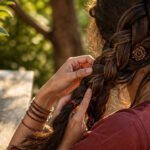
Braids earn their place in winter because they solve two problems at once: they look finished and they keep hair from rubbing against wool scarves and coat collars. Dry winter air already leaves strands brittle, and the friction of pulling a hat on and off all day turns that brittleness into actual breakage. A braid tucked under a beanie or wrapped into a low bun keeps the hair shaft aligned and protected.
The styles that actually survive a commute under a hat are the ones that sit low and flat. A braided crown or braided updo works here: both keep ends secured and off the neckline where scarves create the most friction. Dutch braids or French plaits hold tighter than a simple three-strand and stay neater when compressed. For a polished version, a braided bun keeps everything contained; the key is braiding first, then pinning, rather than twisting loose hair and hoping the pins grip.
What convinced me, reading through the styling notes, is the prep step. A lightweight leave-in conditioner applied before braiding keeps static down, and a smoothing oil-serum on the ponytail section itself prevents the fuzzy halo that winter air seems to generate within an hour. The braid functions as both style and shield, but only if the hair underneath stays hydrated enough not to snap when you take it down at night.
Messy Buns

A messy bun reads as styled rather than lazy in winter because the season gives you texture for free: static from wool coats, slight grit from dry shampoo, and the natural bend hair takes after being tucked under a hat all day. Second- or third-day hair actually performs better here, since clean strands slide right out of an elastic and refuse to hold that deliberate looseness.
The trick that keeps it from collapsing under a coat collar is placement. A true top knot, gathered high and twisted loosely, sits above where any collar hits. Tease the crown for volume before you pin, and leave a few tendrils out around the face so the overall shape looks soft, not slept-on. If you are coming from a half-pony, the same texture rules apply, gather everything up rather than splitting it.
A small amount of leave-in conditioner or anti-frizz product on your palms before you start keeps the static from turning into a halo, but skip anything too heavy. The style lives on contradiction: enough grip to stay, enough movement to look like you did not try too hard. Pair it with a chunky scarf and the whole thing clicks into place.
Full Blunt Bangs

A straight, heavy fringe cut right across the forehead can refresh your whole look without sacrificing the length you’ve spent months growing out. Every two weeks is the trim rhythm blunt bangs demand, which sounds aggressive until you realize how fast forehead hair grows and how quickly the shape goes from polished to shaggy.
The drama of this cut pairs naturally with winter’s architecture: sharp shoulders on wool coats, clean lines of leather boots, the graphic quality of a turtleneck frame. Where wispier fringe gets blown back by January wind or fights with a hat, the density of a full blunt bang stays legible and intentional.
Length is the decision that makes or breaks it. Chicago stylist Raven Hurtado sees the appeal in how dramatically this changes your appearance without requiring a color overhaul or major chop. Go too short and you’re in micro-bang territory, which reads playful in summer but can skew costume against heavy winter layers. Go too long and the weight drags, blunting the geometry that makes this style sharp in the first place.
The commitment isn’t to the cut itself but to the calendar. Factor in those salon visits before you sit in the chair.
Wolf Cut

Shaggy layers with volume at the crown and tapering ends define the wolf cut, and the disconnection between top and bottom layers works better with winter hats than any neatly blended cut. The shorter upper layers collapse slightly under a beanie or beret, then spring back when you take the hat off. The longer lower layers stay flat against your neck and shoulders, so you do not get that mushroom silhouette that makes you reach for a hair tie.
Dry indoor air does this cut favors rather than damage. The lived-in texture, what stylists describe as slept-in or rumpled, is the point, not a problem to fix. The cut was built from 1970s Joan Jett and 1990s Courtney Love references, the shag revived with TikTok urgency. Stylists call it "disconnected" because the graduation is abrupt, not feathered, which means less precision required every morning.
The crown volume sits above where most hats hit, so the flattening is temporary and the recovery instant. That alone makes it practical for women who move between overheated offices and freezing streets.
Butterfly Cut

The butterfly cut lives in that space between long and short, with the shortest layers angling from the cheekbone and the longest falling somewhere past the shoulder. What sold me on trying it was watching how those face-framing pieces behave when you pull on a coat. Tucked into a collar, they still escape at exactly the right length to soften the jawline. Left down, they create that oval shape around the face that makes winter layering look intentional instead of swallowed.
The blow-dry is where the cut earns its name. A round brush pulls each section upward and outward, not under. The motion is out from the face at a forty-five degree angle, almost like you’re trying to bend the hair away from your head rather than curling it in. The heat hits the roots first, then you chase the brush down the mid-lengths without rolling the ends. When you finish, the layers fan outward instead of falling straight. Two passes with the cool shot button, still brushing outward, set the shape so it holds through the day.
The catch is the grow-out. Those shortest layers need trimming every eight weeks or the whole shape collapses into something closer to a shag. If you stretch salon visits, the cut starts working against you.
Vintage Finger Waves

The sculpted, S-shaped ridges of vintage finger waves sit almost flat against the scalp, a formal style that has resurfaced this winter as an answer to the usual heat-tool fatigue. I first noticed the return when stylists started referencing Old Hollywood glamour as the antidote to fast-trend exhaustion, and the appeal makes sense for a single night out: you get the polished impact of a blowout or curling-iron set without the damage.
The technique relies on strong-hold gel and a fine-tooth comb, not hot tools. Working on damp, gel-coated hair, you press the comb flat to the head and push forward, then reverse the motion to create each ridge, pinning each wave in place to set. Straight hair takes the wave directly; wavy or curly textures need smoothing first with an iron before the gel and comb work. After a few minutes, the pins come out and a strong-hold spray locks the shape.
For winter events, this functions as a genuine alternative to heat styling. One application, no tools touching the hair again, and the result reads as intentional rather than makeshift. An embellished slide at the temple finishes the Great Gatsby reference without requiring anything else to compete.
High Ponytail with Wrapped Bun

A high ponytail twisted and wrapped into a bun sits right at the crown, which sounds like it would fight a turtleneck but actually solves the problem a lower bun creates. The height clears the collar band entirely, so you’re not adjusting either piece all day. What convinced me, reading through a dozen tutorials, was the specific pinning pattern: two crossed bobby pins slid through the elastic before you start wrapping, then a second pair anchored in an X shape once the twist is done. The base stays concealed because the wrap starts from the ponytail itself, not from below, so no elastic shows and nothing catches on a scarf. A full day of wear, including pulling a coat on and off, held fine with this double-X method where single pins always slid by hour three. The crossed anchor at the elastic is the part that keeps it from dropping. Fine hair benefits from a texturizing spray before styling so the twist has grip; otherwise the wrap loosens by late afternoon.
Knotted Scarf Updo

A silk scarf knotted around a low bun at the nape solves the hat-hair problem before it starts. The fabric acts as both barrier and accessory, so you remove your coat and your hair looks styled, not flattened. Wool grips without slipping, while silk or satin gives the same hold with more polish; both work because the texture catches against the bun rather than sliding off smooth hair.
The knot placement matters more than the fabric. Sources describe two workable positions: tied directly over the bun itself for a tidy, tucked finish, or secured above the nape with ends left to cascade below the neck. The first reads deliberate, almost French; the second gives more coverage against wind. Either beats the look of a scarf hastily wrapped to hide static.
Loosening a few strands around the face keeps the style from feeling too done. A tight bun with a tight scarf turns into costume; the slight softness is what makes it wearable for coffee or the office.
Winter Hair Color

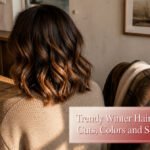
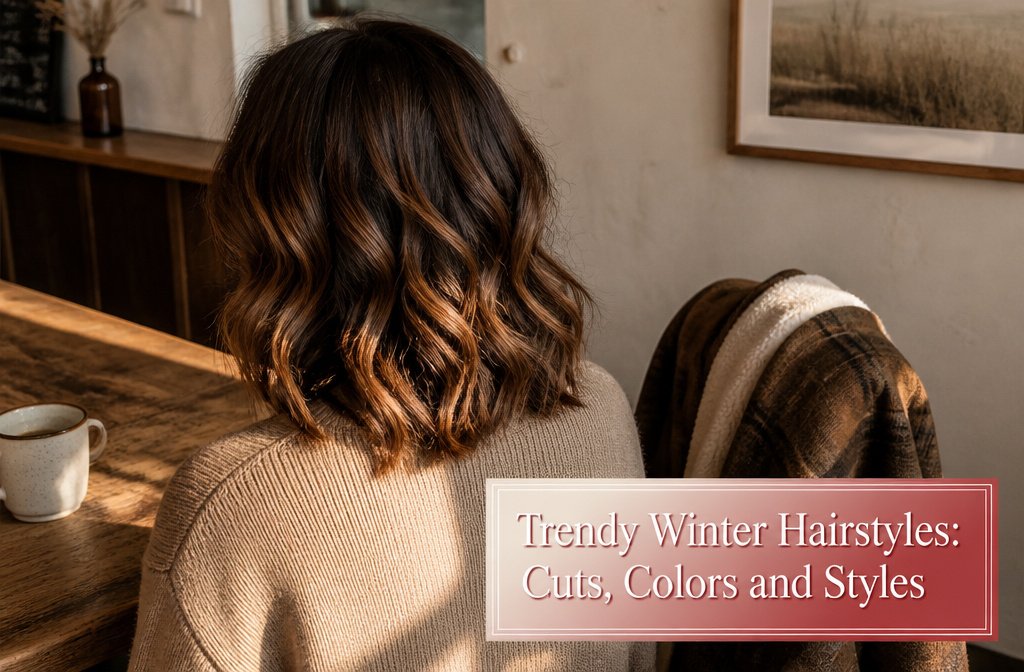
Rich chocolate browns, smoky bronze, and velvet gold are the tones showing up in salons right now, and after years of going lighter every May, the shift back to depth feels less like a trend and more like a reset. Summer’s sun-kissed highlights can turn brassy under pale winter skin and flat indoor lighting; the warm, reflective quality of a milk-to-dark chocolate brunette adds back the dimension that winter light strips away.
Cowboy copper sits on the warmer side of red, while cinnamon pulls cooler with blue undertones that almost verge on purple. Both fade fast, so a pigment-depositing conditioner between appointments keeps the tone from going flat. For blondes who aren’t ready to commit to brunette, a neutral blonde balayage blended with cinnamon lowlights gives depth without the full plunge. Chestnut and spiced chai tones do the same work on medium-length cuts, catching whatever gray daylight there is and bouncing it back as something that looks alive.
Hair Care for Dry Months

Cold air holds almost no moisture, which means water molecules inside the hair shaft migrate outward through the cuticle faster than they can be replaced. Dr. Joe Cincotta, a chief chemist who studies this, describes it as a constant outward leak: the lower the humidity, the faster the hair dries from the inside. That tight, straw-like texture that shows up around January is not surface damage alone; it is structural moisture loss.
A moisturizing shampoo and weekly deep conditioning mask are the minimum here, not luxuries. The mask sits long enough to push moisture back through the cuticle layers rather than just coating them. I skip the hot tools on the days I can; even with a protectant rated to 450°F, the cumulative drying from a blow-dryer on already depleted hair is hard to undo. Static is the giveaway symptom, and a lightweight serum or a dab of leave-in conditioner on the ends handles it better than anything designed to fight frizz in summer humidity. Air-drying before stepping outside helps too, since wet hair exposed to freezing air contracts and weakens faster than dry strands.
Heat Tools and Protection

Winter air already pulls moisture from every strand, so the tools you choose matter as much as the cut. A heat protectant is the non-negotiable first step, and the application matters: spritz on damp hair before any blow-dryer or iron touches it, not after. Lowering the temperature on your tools keeps the damage from compounding what the cold already started. Dry hair in January does not need 450°F; it needs the lowest setting that still sets the style.
Air-drying can finish presentable if you plan for it. Work a styling cream through damp hair, skip the roots so they do not flatten, and let the shape form as it dries. A diffuser attachment helps if your texture needs definition without the full blast of heat. For the ethereally waved looks trending this season, this approach saves both time and breakage. The result should look intentional, not like you gave up halfway. When a few pieces need polish, a one-inch curling wand on select sections does the job without requiring a full hot-tool pass over hair that has already been through enough.
Accessories That Work

Velvet scrunchies and pearl hair clips grip slippery winter hair better than slick metal or plastic, which is why they have become the pieces I reach for once the humidity drops. Chunky headbands serve a double purpose: they add drama to a flat ponytail after you pull off a hat, and the fabric layer keeps ears warm without the pressure of a tight beanie. Sparkly barrettes work best in half-up styles because they anchor the section that loses volume first under wool, catching light at a dinner table even when the rest of your hair has gone limp from static.
The real limit is temperature. Anything with a thin metal hinge or cheap plastic claw tends to snap in real cold, so I stick to fabric-covered bases and thicker acetate when I am walking any distance outside. An oversized clip can hold a low bun together through dry-air flyaways that would slide out of an elastic by noon. It is not about collecting every trend; it is about choosing the two or three shapes that actually stay put from your morning commute to the moment you take your coat off.
Frequently Asked Questions
What are the most popular haircuts for this winter?
The chin-length bob, curly crop, mid-length chop, and blunt lob lead salon requests this season. The chin-length bob sits right at the jawline to clear coat collars and scarf knots, while the curly crop hits mid-neck to cut drying time in cold air. The mid-length chop lands between collarbone and shoulder for easy tucking under winter layers, and the blunt lob uses its solid edge to press down static where dry indoor air creates it.
What is the winter hair color trend?
Velvet gold, smoky bronze, and cowboy copper are the standout shades for 2026. Copper rose, a bright copper base toned with diluted pink or peach glaze, also gained traction as an ’80s-inspired option that reads fresh rather than brassy. Glossing treatments keep these colors luminous against winter’s flat light.
How can I take care of my hair during the winter season?
Moisturizing shampoos and deep conditioning treatments form the base of winter haircare, since low humidity pulls moisture from the shaft and leaves strands brittle. Minimize heat styling where possible, and apply a leave-in conditioner or protective serum before going outside to shield hair from cold air and wind. Sleep on silk or satin to reduce friction breakage, and wash with warm rather than hot water to preserve natural oils.