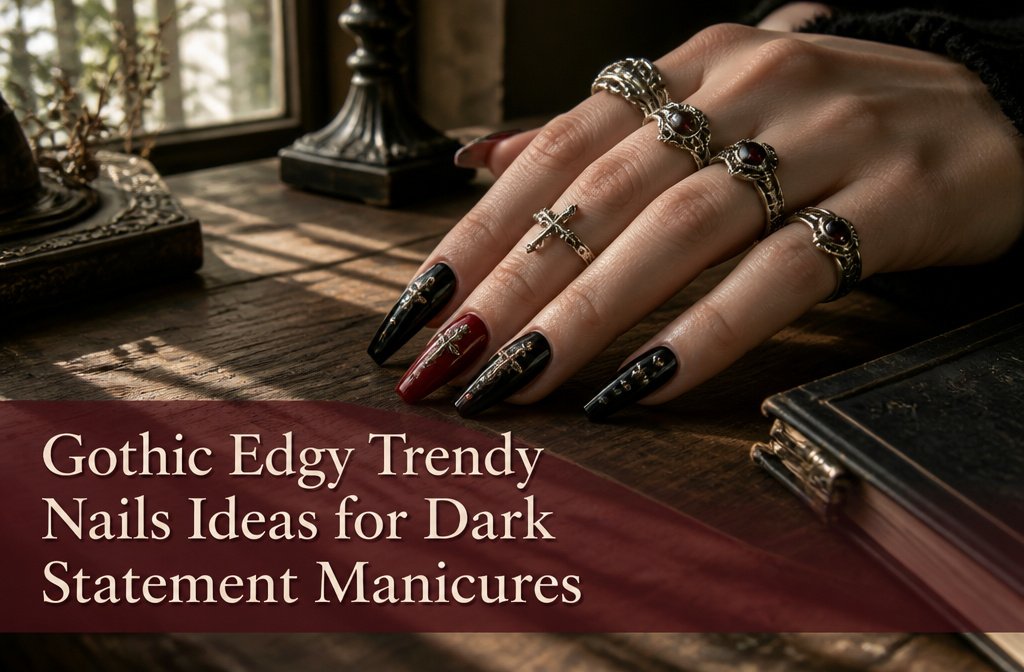
Gothic edgy trendy nails ideas are specific manicure designs that use dark color palettes, architectural shapes, and dimensional textures to make a statement without reading as seasonal costume. The difference between a manicure that works in March and one that gets boxed away with Halloween decorations usually comes down to finish and proportion: a chrome overlay on black polish shifts from office-appropriate to dramatic depending on the light, while 3D charms under 4 mm survive daily wear without snagging on sleeves. The coffin shape itself carries much of the effect, its flat, squared tip creating shadow and weight that rounded silhouettes simply do not.
Chrome Nails
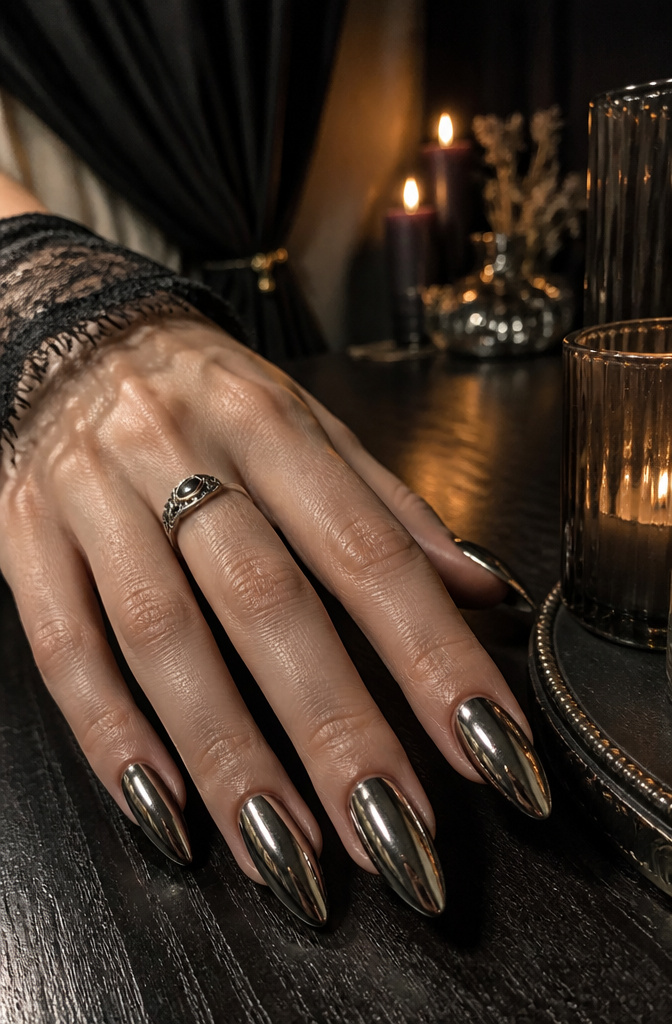
Chrome nails catch light in a way matte or glossy finishes simply do not. The reflective surface shifts from mirror-bright under direct bulbs to moody and liquid in dim corners, which is exactly why they work for a gothic manicure rather than against it. Silver chrome reads edgy and futuristic, but pair it with a black or deep red base and the whole thing turns dark and deliberate rather than space-age.
The base color matters more than most people expect. A sheer pink under chrome gives that standard salon look; layer the same metallic powder over deep burgundy or black and the reflection pools differently, warmer and more unsettling. Red and black gothic color schemes are the obvious companions here, though deep purple bases hold their own if you want something less expected. Black base with silver chrome overlay wins for actual gothic impact; the darkness stays visible at the edges and underneath when the light hits at an angle, which is most of the time your hands are in motion.
I have watched this finish go from niche to everywhere in about two seasons, and its staying power makes sense. Chrome powders are a top trend for gothic manicure aesthetics right now because they bridge the gap between wearable and dramatic: office-appropriate distance, statement-making up close.
3D Nail Charms

Large silver or gold metal charms in spiderwebs, skeletons, tombstones, crosses, and roses are what separate a flat dark polish from a gothic statement that gets noticed. The 3D element itself is what is trending right now across nail communities, not the specific motif, so the gothic interpretation reads current rather than costume.
Daily wear demands a different scale than a weekend event. Charms under 4 mm sit flat enough against the nail to survive typing and pocket-dips without catching on knit sleeves or hair. Anything larger belongs on accent nails only, and even then, gel polish underneath buys you the two-week wear window that regular polish cannot promise. Regular polish with a heavy charm lifts in 3 to 7 days, sometimes faster if water gets under the edges.
Adhesive choice matters more than the charm itself. Nail glue from the drugstore works for a single night; a brush-on resin gel cured under a lamp holds through hand-washing and gloveless chores. The real failure point is the gap between charm and nail. A charm that rocks slightly will snag, then lift, then take polish with it. Press it flush during curing, check from the side, and accept that one heavy piece per hand is the practical limit for anything you plan to actually use.
Airbrushed Nails
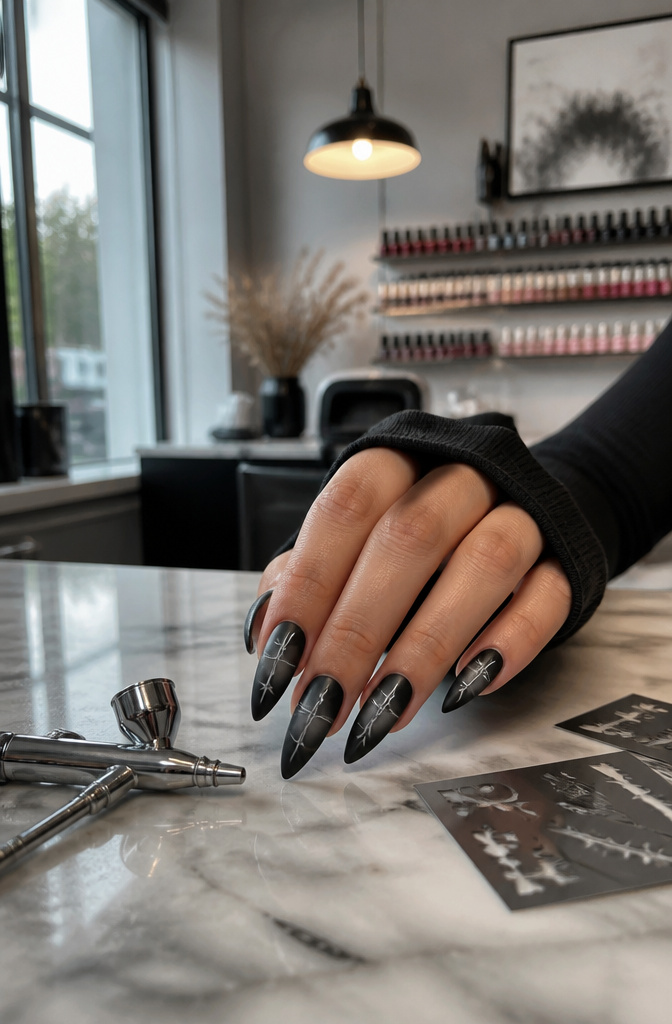
Barbed wire and spider webs look different under an airbrush than they do with a striping brush. The stencil or freehand spray softens every edge into a gradient, so the gothic symbol reads as atmosphere rather than illustration. That difference is the whole point: hand-painted precision draws the eye to the line itself, while airbrush lets the darker color do the work from a distance.
A home setup needs a small compressor, a dual-action gun, and stencils cut from cardstock or bought as nail-sized sheets. Ventilation matters more than with polish; the acrylic paint is atomized, not brushed, and the particles hang in the air. Salons use the same equipment at higher psi and swap the needle sizes for detail work, which is why their spider webs get those whisper-thin legs that home machines tend to clot.
The softer edge favors large symbols over fine ones. A skull or tribal shape holds up to the blur; lace details, like the kind paired with florals in gothic manicures, lose their structure unless the technician builds them in layers of masked negative space. Most nail artists working dark airbrush stick to barbed wire, webs, and gradient fields for exactly this reason.
Neon Goth

Neon spiderweb nails started as a Halloween move, but the design works year-round if you want color without losing the gothic edge. The trick is which neon reads spooky under daylight, not just blacklight. Acid green and hot pink carry a chemical, unnatural quality that still feels dark; electric orange or highlighter yellow drift toward rave territory no matter what web you paint over them.
Neon pigments behave differently than standard polish. Under blacklight they glow predictably, but under daylight the same shade can look flat or alarm-bright depending on the base. Sheer black underneath tames the saturation and gives the web its depth. Without that dark ground, the neon dominates and the gothic register collapses into costume.
For gothic edgy trendy nails ideas that hold up past October, neon green skeleton art on a coffin shape keeps the balance: the elongated nail gives room for detail, the skeleton keeps it macabre, and the green stays acidic enough to feel intentional rather than accidental. Press-on options exist if you want to test the look before committing to a salon set.
Tribal Designs
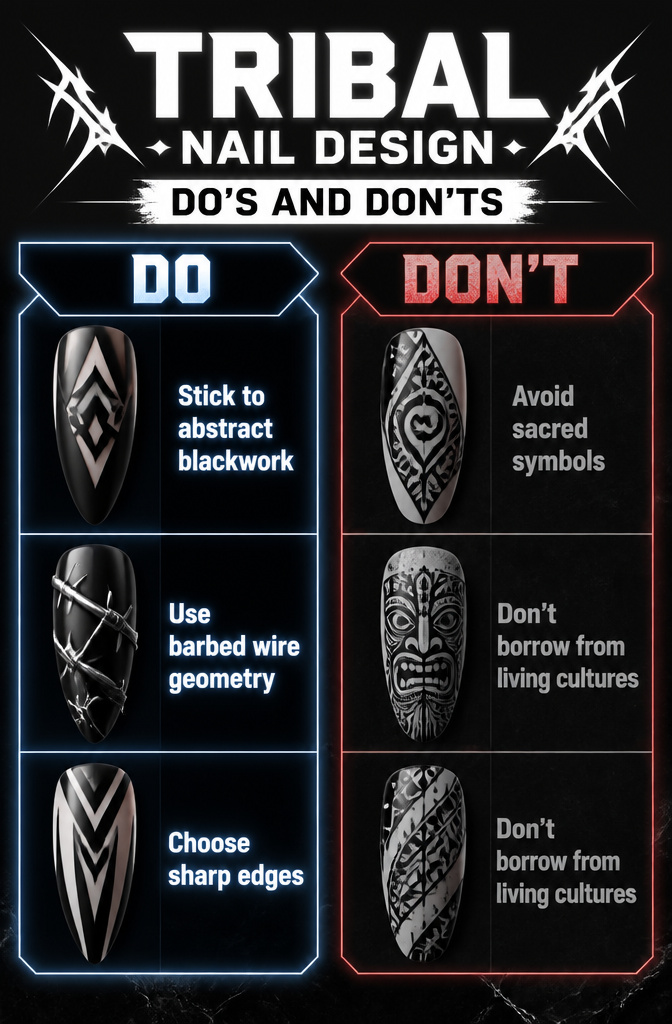
Sharp-edged patterns borrowed from the 90s and early 2000s are showing up again on goth nails, and the look can land well if you are careful about what you are actually borrowing. Back then, tribal designs turned up everywhere: tattoos, bedazzled t-shirts, car decals. The modern style of these patterns drew from Polynesian cultures, including Hawaiian, Maori, and Tahitian, which means a lot of what circulated was sacred imagery stripped of context.
Stick to barbed wire geometry and abstract blackwork rather than anything that resembles specific cultural symbols. A nail technician can build a sharp, aggressive pattern from straight lines and angles without touching designs that belong to living communities. If you are not sure whether a reference is generic 90s nostalgia or something more specific, that uncertainty is the signal to leave it out. The edgy effect comes from the contrast and the precision of the edges, not from the origin of the shape.
Black Ombré
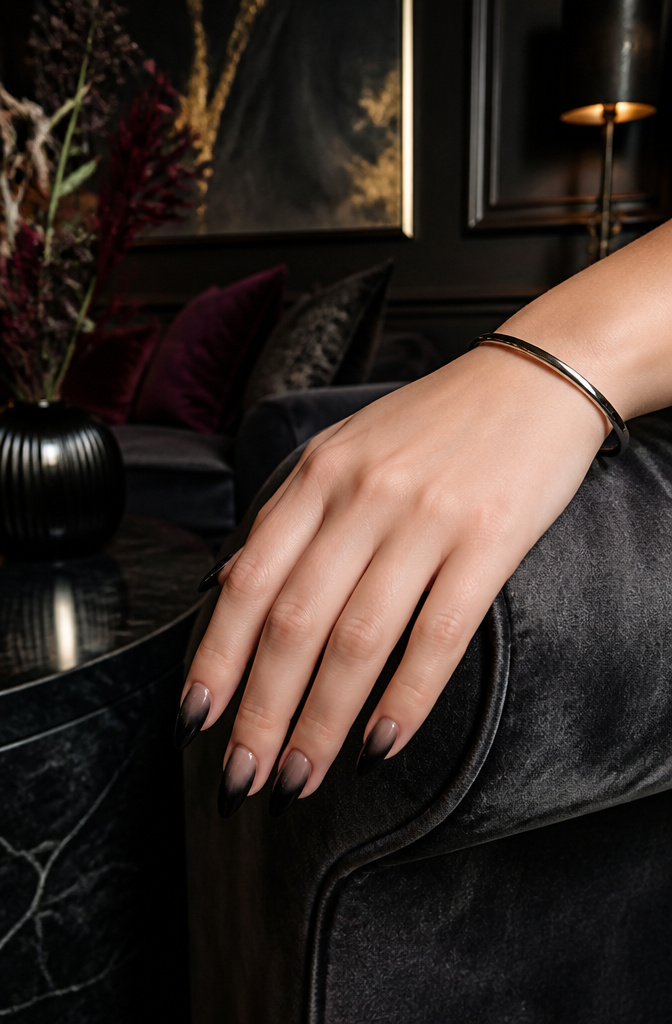
Black ombré polish lands in that sweet spot between wearable and theatrical. The gradient reads as subtle from a few feet away, then reveals itself as something darker up close. Most gothic manicures that use it start with a sheer nude or pale pink base and let the black fade in toward the tip, which is where the vampire French comparison comes from. It looks like the nail has been dipped in something.
The sponge versus brush question matters more here than with lighter colors. A makeup wedge gives you that soft, diffused edge because it literally stamps the pigment on in thin, overlapping layers. Three or four passes, letting each one dry to the touch, builds a gradient with no hard line. A brush demands more control: you lay down a thin stripe of black at the tip, then drag a clean, slightly damp brush back toward the cuticle before the polish sets, feathering the edge as you go. The brush route risks a visible streak if your pressure is uneven, and black shows every flaw. The sponge wins if your hand is not perfectly steady, which mine rarely is.
The TikTok numbers on witchy aesthetics are hard to ignore. The hashtag #witchtok had already racked up 30 billion views by October 2021, and nail art feeds into that same hunger for something that reads as occult without requiring a full costume.
You could even incorporate ombré, but make it a little more gruesome than usual.
— Nylon
That gruesome turn is where the black ombré gets interesting. A red base instead of nude, with the black bleeding down from the tip, gives you the blood-pool effect without literal drips. It still counts as a French manicure structurally, but the color story is what makes it gothic.
Dragon Nails
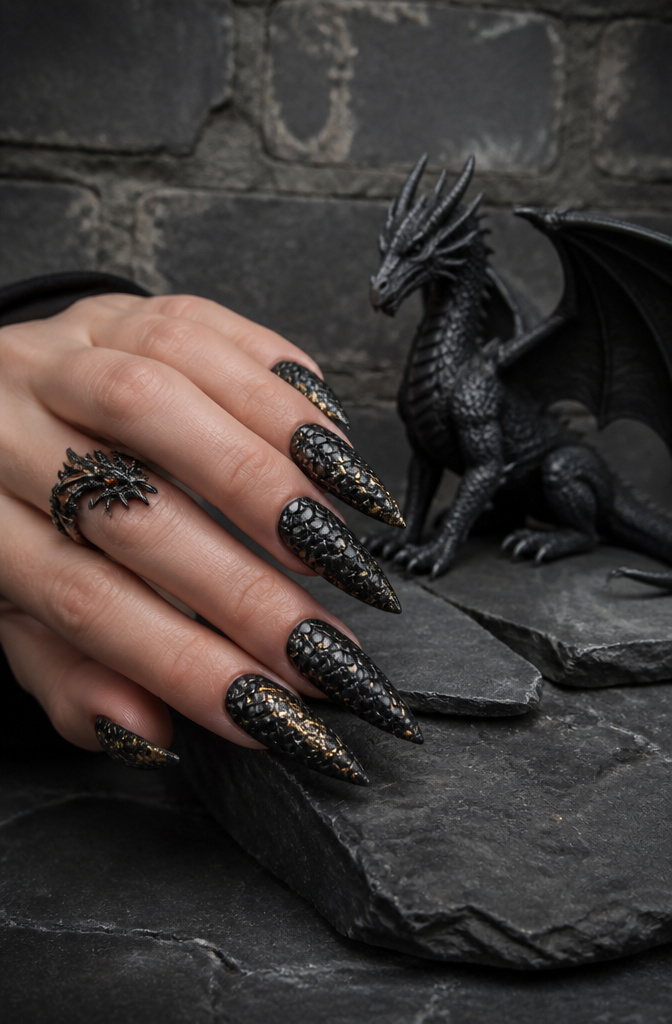
Dragon nails pull the animal-print trend toward something entirely invented: a creature that never existed, rendered in texture against black polish. Scales built with stamping or freehand work catch light at their ridges and sit in shadow at their centers, which reads as more dramatic than flat painted art ever manages.
Gold foil laid over black makes the motif readable without surrendering the dark base. The contrast matters; matte scales against a glossy ground, or the reverse, do the same job with subtler tools. What convinced me, looking through enough of these, is that the dimensional version wins for evening when the light shifts, while flat dragon patterns read closer to costume. Two ways to play it: keep the scale texture to an accent nail and let the rest stay pure black, or run the dragon motif across the full set with the texture concentrated at the cuticle or tip. The accent nail wins if your day involves typing; full texture catches on everything.
Coffin Shape
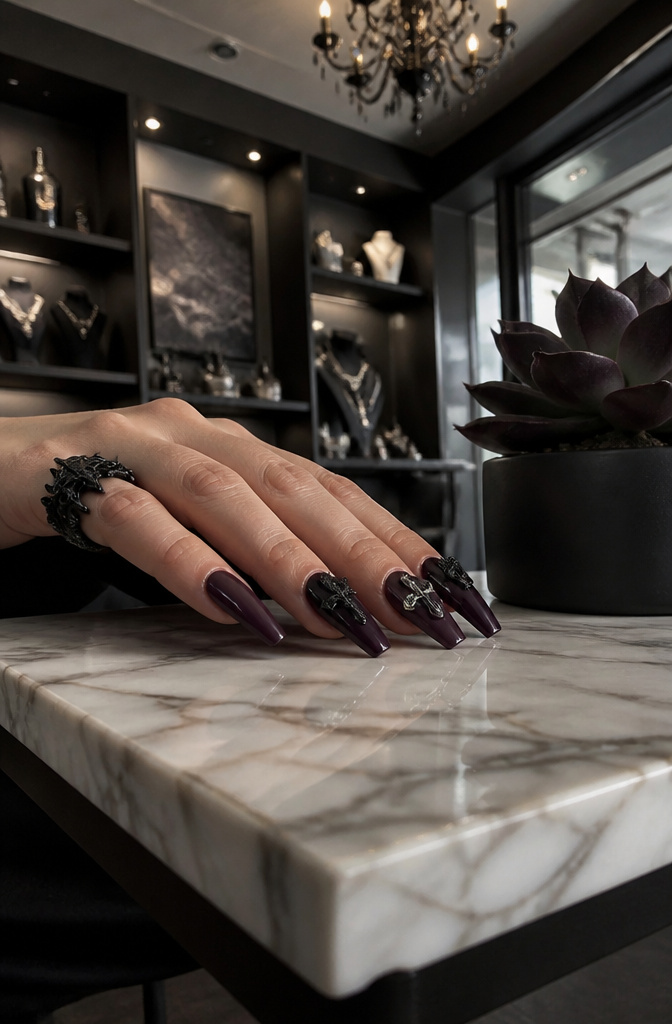
The coffin shape carries gothic edgy trendy nails ideas better than almost any other silhouette because the flat, blunt tip reads as architectural rather than playful. I learned the distinction the hard way after asking a technician for "coffin" and walking out with what she called ballerina, the difference being subtle but decisive once you know to look for it.
Both shapes taper from the nail bed toward the free edge, but ballerina keeps a soft, curved tip like the toe of a slipper. Coffin squares that edge off completely. That missing curve is what makes the shape feel severe, almost weapon-like, especially in the matte blacks and deep plums that dominate this aesthetic. Rounded alternatives, even almond or stiletto, draw the eye along a continuous line; the coffin’s abrupt stop creates shadow and weight at the fingertip that photographs harsh and deliberate.
The flat edge also gives you more surface area for the details that define dark statement manicures: straight-line chrome strips, cemetery scenes, or negative-space webs that would distort on a curved tip. In my experience comparing shapes for this look, coffin wins when you want the nail itself to look like an object rather than an accessory.
Vampire Nails
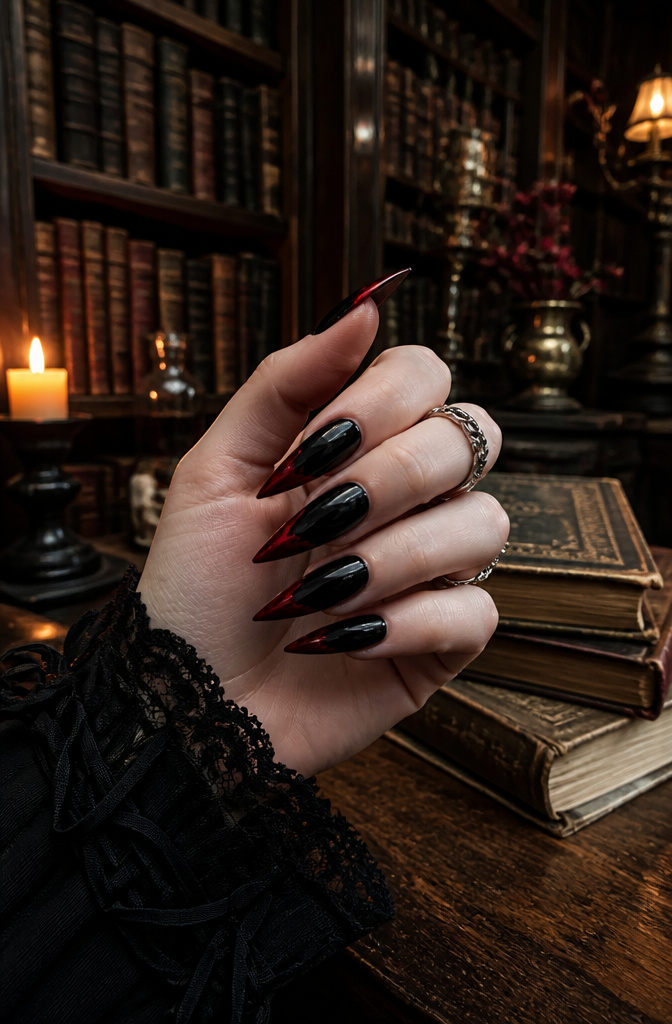
Blood-red bases carry the vampire nail look further than most gothic edgy trendy nails ideas expect. The trick is making those drips look wet rather than painted. A glossy top coat layered over still-tacky polish does it, or working with a thick builder gel that catches light like real fluid. Two ways to play this: keep the red as a single statement nail against black, or run the drip from cuticle to tip across every finger. The single accent wins if you wear rings that compete for attention.
Long stiletto nails in rich black polish make a bolder statement here than any other shape. The extreme taper catches light in a way that reads almost weapon-like, which suits the vampire reference more than a softer almond ever would. Metallic accents can add sophistication if the all-black feels too flat, though I tend to skip them. The shape itself does enough work.
Gothic Cobwebs
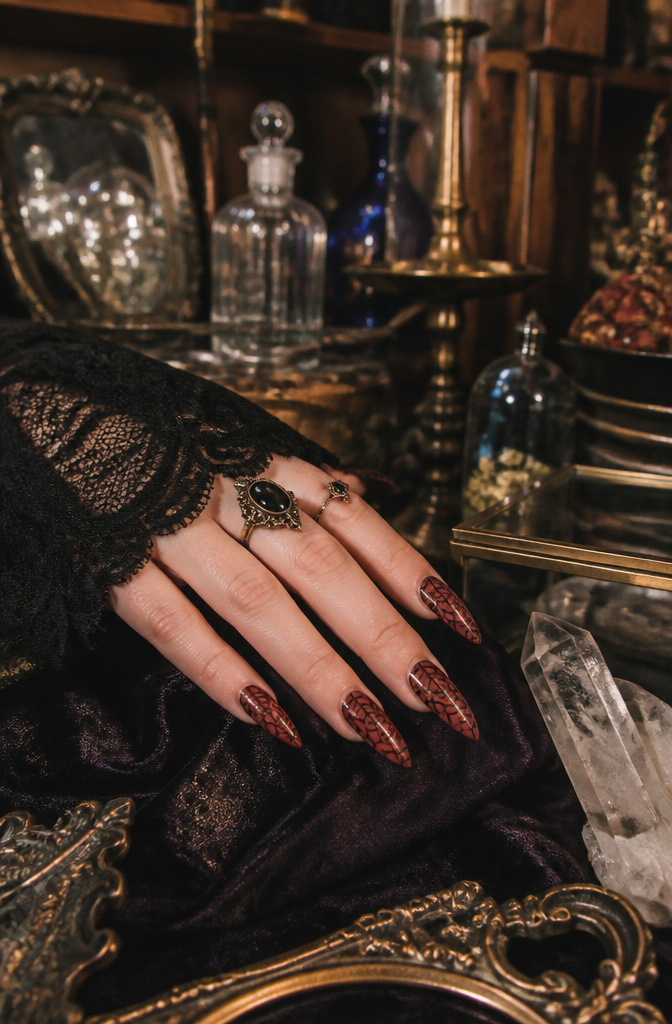
Black cobweb details on a scarlet base read elegant rather than costume when the spacing between threads is deliberate. Negative space is what separates a refined gothic manicure from a Halloween sticker job, so the technique for laying down those lines matters more than the color choice.
Single-strand work, painted freehand with a striping brush, lets the artist vary the gap between each thread so the web breathes. Stamped webs from a plate give you speed and symmetry, but the spacing is locked in; if the pattern is too dense, the scarlet underneath disappears and the design flattens. Most of the versions that look expensive year-round, not just in October, leave at least as much red showing as black.
A medium almond shape carries the look well, the length giving the web room to spread without crowding the cuticle. Chrome accents in silver alongside the red and black can push the whole thing toward a cooler, more futuristic gothic feel, though the cobweb itself stays the focal point if you keep the metallic to a single feature nail or a thin framing line.
Halloween French Tips

A classic French tip becomes something else entirely when you swap the white arc for a deep violet, orange, or black smile line. The placement of that curve controls whether the mood reads gothic or just seasonal costume. A crisp, high arc near the free edge keeps the shape elegant; drop it lower toward the middle of the nail and the same colors suddenly look playful, even cartoonish. For a gothic result, keep the smile line tight and elevated, almost architectural.
Color choice matters more than you might expect. Purple and black read as year-round gothic because they carry the darkness without the holiday association. Orange, even in a precise French tip, veers straight into pumpkin territory unless you pair it with a black base coat that drags the whole look back toward something vampy. Blood-drip detailing can push orange or red into gothic territory, but that belongs to a different manicure style entirely.
Metallic accents, a thin twinkling line above the dark tip, add dimension without breaking the mood. The scalloped edge some designs use softens the geometry; whether that charm works for you depends on whether your taste runs eerie or elegant.
Chic Gothic Lace
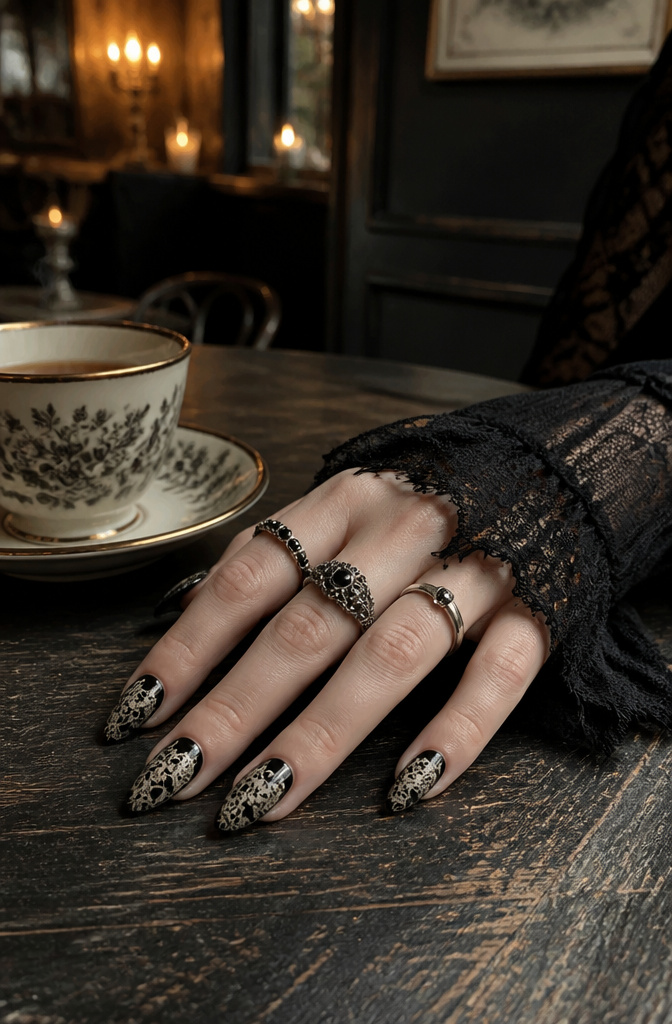
Floral lace on a black base reads romantic until it reads funereal, and the shift happens in the finish. Matte lace sits flat and reads like mourning fabric, the kind you see pressed into vintage stationery; glossy lace catches light at the edges and suddenly looks like vinyl lingerie from a 1990s music video. Both work for gothic edgy trendy nails ideas, but they are not interchangeable moods.
Hand-painting the filigree wins on control. A detail brush lets you decide which petals dissolve into the base and which stay crisp, and you can ghost the pattern out toward the cuticle instead of stopping at a hard decal edge. Decals, though, give you the tight weave that most of us cannot freehand without a tremor showing. The compromise: paint the broad floral shapes yourself, then layer a single decal of dense netting over one accent nail so the eye has something precise to land on.
I tried the full-hand-painted route once, spent ninety minutes on one hand, and still had a thumb where the lace looked more like cracked pavement. The decal nail was the only one that photographed. Now I mix the two without apology.
Vampy Red
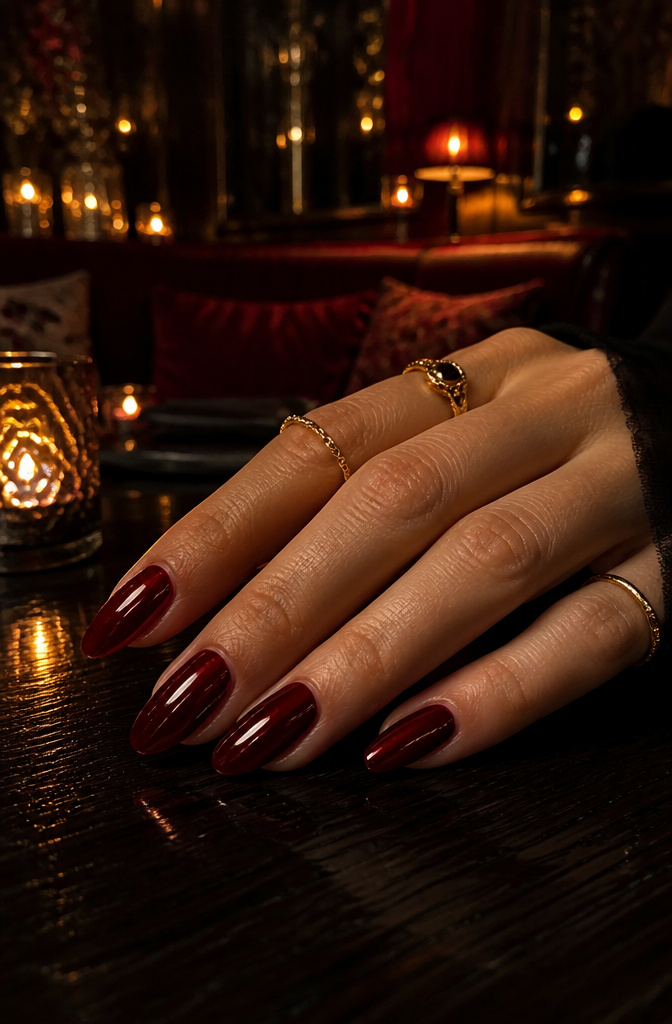
A true vampy red reads closer to burgundy or dried blood than to cherry or fire engine. That blue-red or brown-red depth is what separates Gothic intent from retro pin-up energy, and the distinction matters because the wrong undertone turns your statement nail into a costume prop.
Black cobweb detailing over scarlet, set on a medium almond shape, keeps the look refined enough for year-round wear rather than limiting it to October. The TikTok witch aesthetic has made blood-inspired manicures more visible, but the execution that lasts pulls from elegance rather than gruesome novelty. An ombré approach can work here, though the gradient needs to stay muted and a little dirty to maintain the Gothic mood.
Choosing this specific red is where self-expression lands. Retro reds broadcast optimism; vampy reds withhold it. That restraint reads as confidence, and on nails it becomes a quiet power move you do not have to explain.
Bloody French Tips
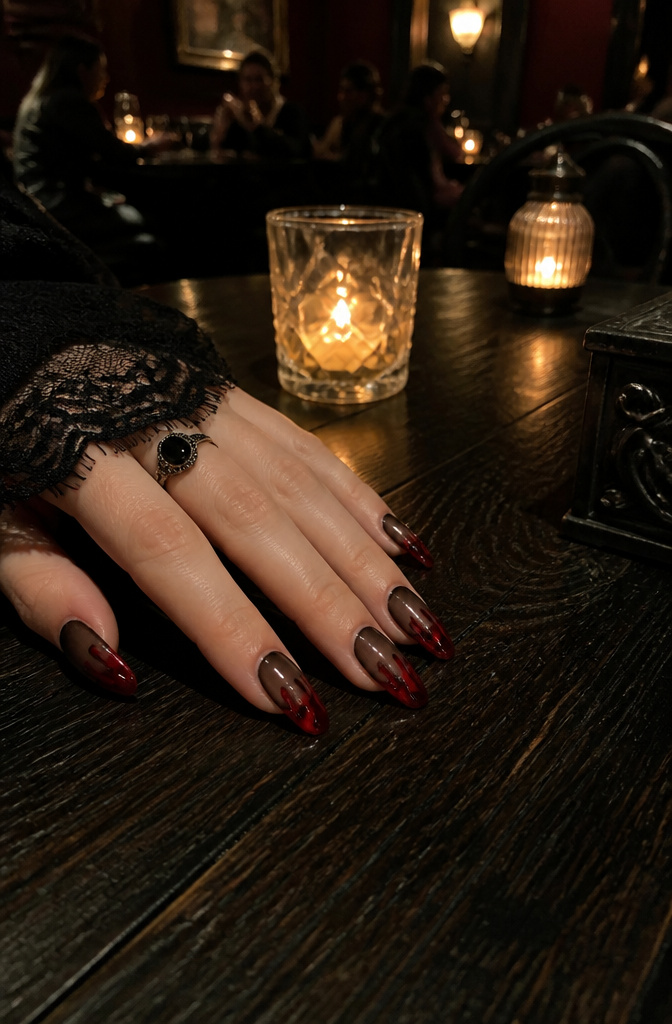
The gradient technique is what separates a blood-drip manicure from a mess that looks like a kitchen accident. A black base sets the stage, and from there the red polish transitions from dense at the cuticle to sheer at the tip so the color reads as liquid rather than painted-on solid. That transparency at the edges catches light the way actual fluid would.
Positioning matters more than precision. A single, thick drip running from the center of the nail carries more weight than scattered specks. Two thinner drips framing it, offset slightly, create the tension of something just starting to run. Spreading them across every nail evenly turns dramatic into costume-fast; keeping the heaviest drip to the ring finger or middle finger, where the eye lands naturally, lets the other nails stay quieter.
The mistake most people make is stopping too soon. The red needs to go almost to the free edge in places, then feather out to nothing, or the liquid illusion collapses. Leave a hairline of black visible at the sidewalls so the drip looks like it belongs to the nail, not like it landed there by chance. A matte top coat over the black, gloss over the red, adds another layer of believability: wet blood, dry leather.
Cemetery Nails

Cemetery nails work best when the tombstone shapes carry real detail. A flat rectangle reads like a mistake, so the trick is adding the slight arch or rounded shoulders most old headstones develop. Paint them in velvet maroon or sultry gray against a deep black ground, and the silhouette already looks weathered rather than drawn from a font.
The background depth matters more than the foreground detail. A single opaque black layer flattens everything, but building two or three translucent passes of black or deep holographic red gives the nail actual distance. The tombstones then sit forward visually without needing thicker paint or more elements. Spider web details, kept to a thread or two, can bridge the stones and the empty ground without crowding the design.
Medium coffin shapes carry this particular layout well. The length gives room for two small stones and the ground between them, and the tapered end echoes the narrowing of old grave markers. Seal with a smudge-free top coat; the thin lines of the web and the edges of the stones are the first to blur if the finish drags.
Dark Manor Manicure
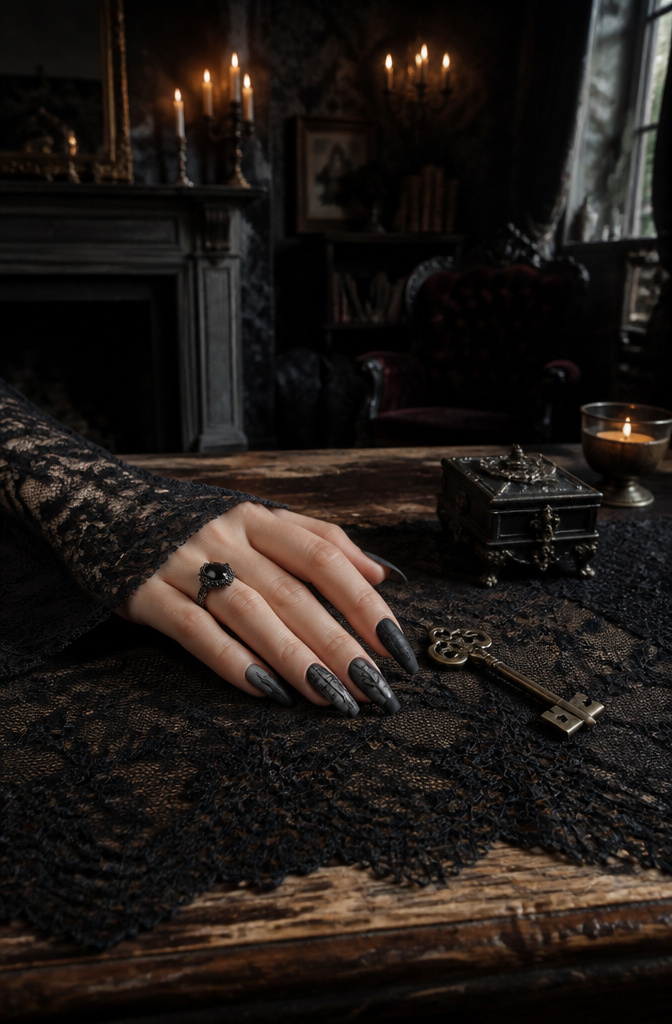
Architectural details shrink surprisingly well to nail scale if you break them into fragments rather than whole buildings. A window becomes a black rectangle with a thin cross, a gate reduces to two vertical bars and a pointed arch. The trick is asymmetry: a balanced manor drawn dead-center on every nail looks like a sticker sheet, but stagger the elements so one nail carries the gate, another a single lit window, a third a corner of cobweb trailing from the cuticle, and the hand reads as one broken facade rather than ten repeats.
The passages favor black and gray for this, with cobwebs stamped along edges rather than floating in the center. That placement matters. Edge-work frames the nail the way ivy frames actual masonry, and it leaves the middle open for the architectural accent to sit in isolation. Medium Almond nails give enough length for a gate arch or a two-pane window without crowding; shorter squares force you to choose between detail and readability. Scarlet red works here too, though that shifts the mood from midnight manor to something more theatrical. Either way, the cobweb detail should overlap the cuticle slightly, as if the nail itself were a wall the web happened to land on.
Haunted House Nails

A deep black jelly base sets the stage for this look, but the real movement comes from iridescent flakes that shift between purple, green, and orange depending on how the light hits them. That color instability is what makes the haunted house theme land: the same nail reads cool violet under office fluorescents and warm amber by candlelight, so the finished manicure never quite settles. The uncertainty of the shift mirrors the unease of a house you can’t trust, where corners seem to move and shadows pool differently each time you look.
Eerie Victorian portraits and skeleton keys painted over the base keep the design from reading as pure texture. The portraits give the nails a narrative anchor, something frozen watching back, while the keys suggest access to rooms you probably shouldn’t enter. Balance matters here; too many elements and the iridescence gets buried, too few and the base looks like an accident. Two or three accent nails with full illustrations, the rest in flake alone, tends to carry the tension without tipping into costume.
Skull Lace
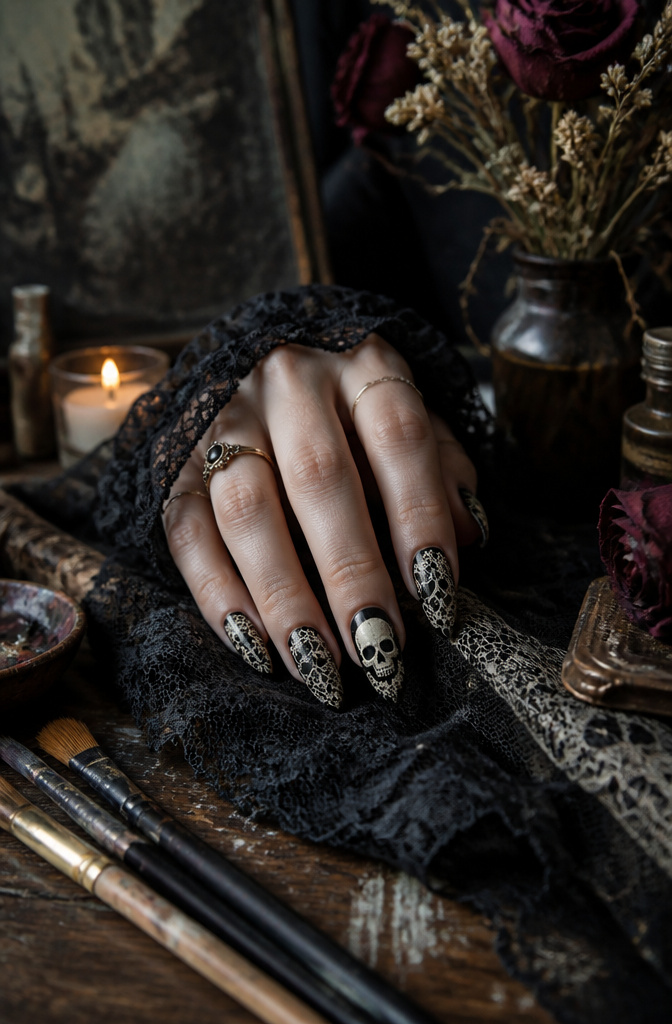
Skull lace manicures live or die on the same tension that makes gothic fashion work in the first place: something fragile pressed right against something dead. The lace needs to read as actual fabric, not just white squiggles, which means building it from fine lines that overlap and let the nail show through underneath. Against that, the skull cannot be tiny or cute. A miniature skull floating in dense lace looks like a sticker from a vending machine; it needs enough mass to hold its own against the pattern’s visual weight.
The skull should take up roughly a third of the nail’s surface, positioned where the lace breaks rather than where it gathers, so the two motifs negotiate space instead of fighting for it. On my own nails, I’ve found that painting the skull in matte black while keeping the lace in a slightly warmer off-white or aged ivory keeps the look sophisticated rather than costume-shop. Too much contrast, and the manicure reads Halloween; too little, and the skull disappears entirely. The lace density matters most at the edges. Fading it toward the cuticle or tip gives the skull room to breathe without abandoning the gothic brief entirely.
Spider Web Nails

Spider web nails live in the tension between perfect geometry and deliberate imperfection. A real web follows radial lines set at precise angles, usually about 15 degrees apart, then fills in spirals that maintain even spacing through what mathematicians call a logarithmic curve. Freehand nail artists approximate this with a center dot and straight lines pulled outward, then connect them with arcing strokes that grow looser toward the edges. The looseness matters: too clean and it reads as Halloween decal, slightly wobbly and it looks like something spun in a corner of your room.
The palette shapes the mood. Black thread on a scarlet base reads elegant and year-round; silver or deep holographic red shifts it toward glam. What changes the whole narrative is one visible spider. A web alone is decoration. Add the spider, even tiny, and the design becomes a scene: something living, something that might move. Sources show this on medium almond press-ons and long squares alike, the shape less important than the placement. The spider belongs at a web intersection, not floating random, so the eye reads it as anchored.
Top coat is non-negotiable here. The fine lines smudge without it, and the whole effect collapses into messy thread.
Red Spider Nails
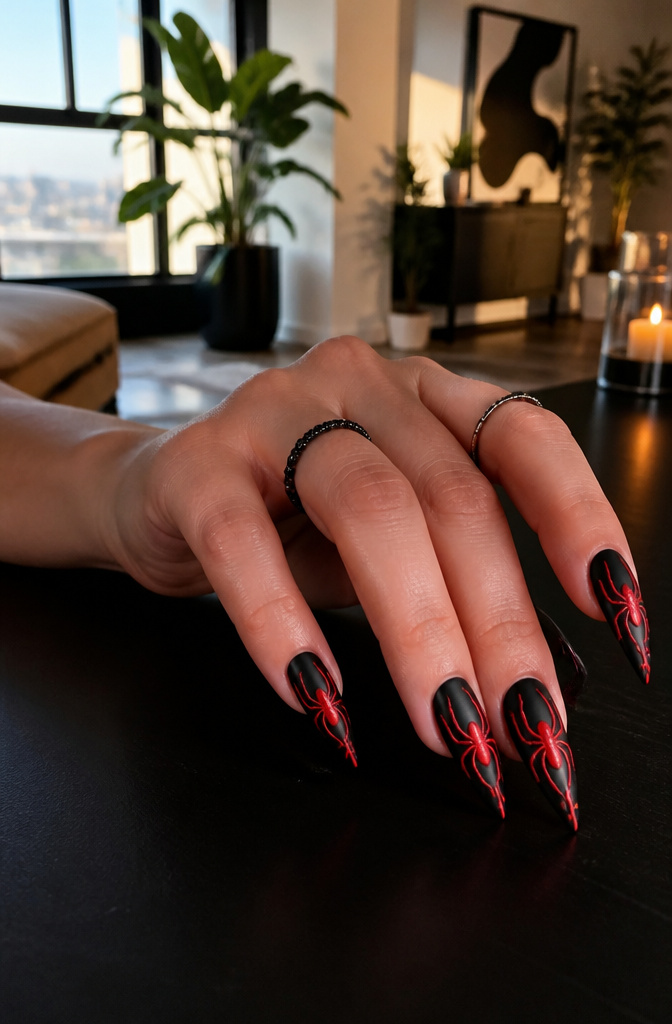
Black polish sets the stage, but the spider itself is what makes this design readable from across a room. I like placing the spider body near the cuticle so the legs stretch toward the free edge; that way the silhouette stays intact when your hands are in motion, not crumpled at the tip where fingers bend. Red accents work best as thin lines tracing one or two legs, or as a single dot marking the abdomen. That spot of color pulls the eye diagonally across the nail, which matters more than you’d think when you’re holding a drink or typing. Too much red and the spider becomes holiday decor; too little and the design goes flat against dark polish. The balance I keep coming back to is one red detail per spider, two spiders per hand, never mirrored exactly. Asymmetry keeps the look edgy rather than costume.
Nail Shapes That Carry the Look

Gothic styles can range from long stiletto nails to short, rounded shapes, and each conveys a different vibe. The shape you choose either sharpens or softens the whole design.
| Shape | Effect on Gothic Designs | Best For |
|---|---|---|
| Coffin | Edgy, architectural; flat tips give skulls and lace a stage to sit on | Statement art that needs room |
| Stiletto | Lengthens fingers, adds sophistication; points amplify spiderwebs and barbed wire | Dramatic, elongated looks |
| Almond | Softens gothic elements slightly; crosses and roses read more romantic than harsh | Balancing dark with wearable |
I started noticing this when I saw the same neon green skeleton art on coffin versus almond shapes. On coffin nails, the flat tip made the bones look almost displayed, like a museum case. On almond, the taper curled the skeleton into something more playful, less stark. The passages back this up: coffin nails are highlighted specifically for that edgy appeal, while stiletto enhances length and sophistication. If you want your gothic edgy trendy nails ideas to read fierce rather than pretty, the shape is doing half the work before polish ever hits.
Color Palettes Beyond Black
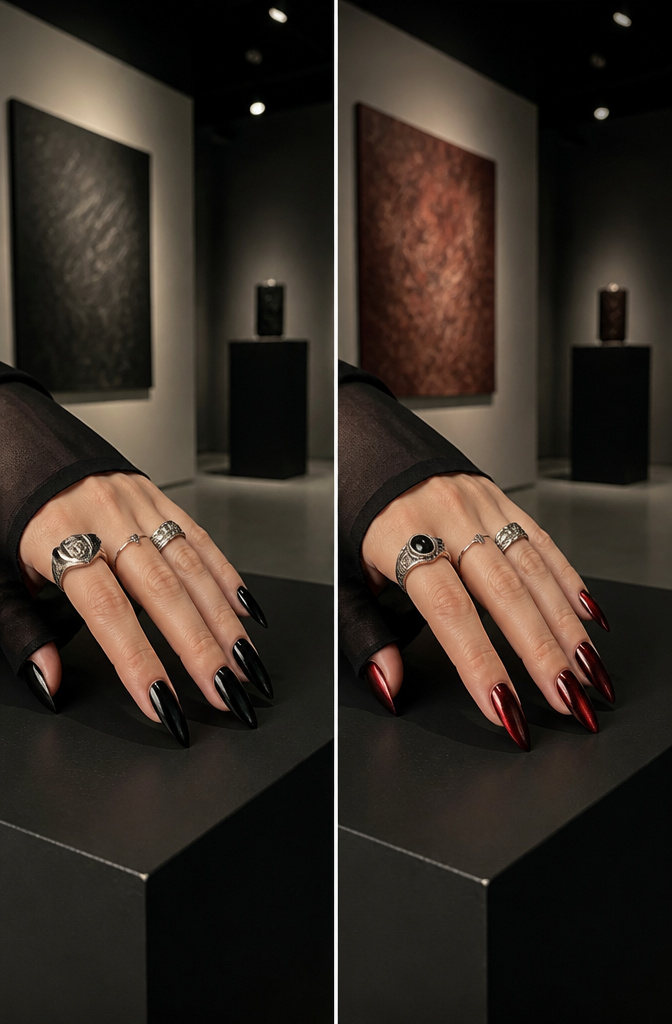
Black and red still own the room, but the palette you choose decides which branch of gothic you’re actually wearing. Deep burgundies and softened purples lean romantic, the kind of look that pairs with velvet and candlelight. Swap those for gunmetal grays, oxidized coppers, or flat industrial taupes, and the same skull motif reads factory floor instead of graveyard. Neon spiderweb nails flip the whole script again; the high-voltage green or electric orange against a black base is pure punk aggression, not mourning. What convinced me, sorting through dozens of these designs, is that the "unexpected hues" aren’t accents. They are the genre shift. A chrome stripe on a black coffin nail is industrial edge. The same stripe in hot pink is Cybergoth club night. The colors don’t decorate the look; they rewrite it.
Keeping the Design Alive
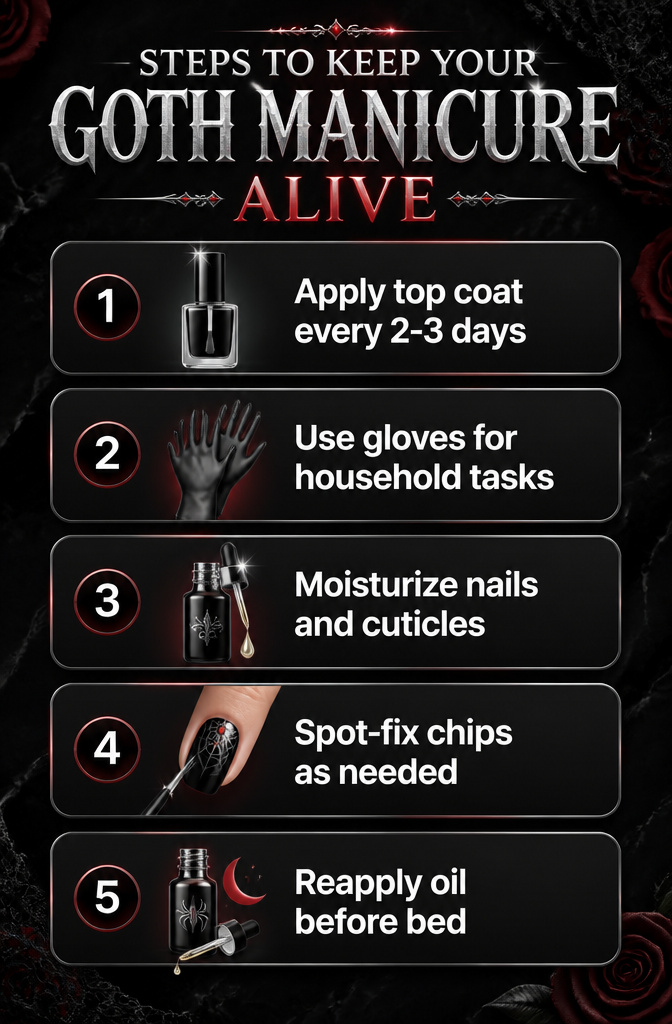
A fresh gothic manicure looks sharp for roughly three to seven days with regular polish, and the drop-off happens fast once it starts. The sources point to two things that stretch that window: sealing the design and keeping the nail itself healthy.
Every two to three days, brush on a quality top coat. This is not about gloss, though it adds that too; it is a sacrificial layer that takes the hit before your spider web or black ombré does. Reapply before you see dulling. The moment the surface goes matte, microscopic fractures have already opened.
Water and household chemicals are the silent killers of dark polish. Gel holds longer, but if you are in regular lacquer, gloves for dishes are not optional equipment.
Cuticle oil and hand moisturizer matter more than people think. Dry nails flex less, crack more, and lift polish at the free edge. I apply oil before bed, not for the ritual but because morning application never survives the first hand-washing. The oil keeps the nail plate supple so the lacquer has something to grip that will not flake away.
Healthy cuticles also mean cleaner lines if you are touching up a chip. Spot-fixing a cracked spider web or a chipped vampire tip is easier on skin that is not ragged and lifting.
When to Wear Gothic Nails

The first time I wore gothic nails to a client meeting, I kept my hands in my lap longer than usual. The design was a delicate floral lace detail on a dark base, which reads romantic rather than aggressive, and nobody blinked. That experience taught me the real question is never "can I wear this" but "which version of this."
Most gothic nail art lives comfortably between two poles. On one end, you have the obvious Halloween references, cobwebs and scarlet bases that signal seasonality from across a room. These work for October parties or nights when you want the look to do the talking. On the other end, lace patterns and refined dark palettes function as everyday personal style, the same way someone might default to all-black clothing without declaring a costume.
Your workplace sets the practical boundary. A medium almond press-on with subtle lace detailing passes in most offices where open-toed shoes are already accepted. Full spider webs on a striking scarlet base probably waits for after-hours, unless your industry runs creative. The maintenance matters too; intricate designs need more touch-ups, and a chipped gothic look reads careless where a chipped nude reads busy.
What convinced me, comparing dozens of these designs, is that the occasion lives in the detail level, not the color. Dark bases are neutral. It is the cobweb, the skull, the theatrical red that assigns the context. Choose the base for your wardrobe, the accent for your calendar.
Frequently Asked Questions
What are some gothic nail ideas?
Chrome nails with black or deep red bases, 3D metal charms in spiderwebs and skeletons, airbrushed barbed wire and webs, neon green spiderwebs over sheer black, black ombré gradients, dragon scale textures, coffin-shaped silhouettes, vampire drip designs, cemetery scenes with tombstones, and haunted house motifs with iridescent flakes all work for dark statement manicures. Each bridges wearable and dramatic in different ways, from office-appropriate chrome to full theatrical cemetery art.
How do you maintain nail designs?
Apply a quality top coat every few days to protect the design and add shine, and avoid harsh chemicals and excessive water that cause chipping. Regularly moisturize hands and use cuticle oil to keep nails healthy; touch up any chips promptly. For 3D charms specifically, gel polish underneath and brush-on resin adhesive cured under a lamp buys the two-week wear window that regular polish cannot promise.