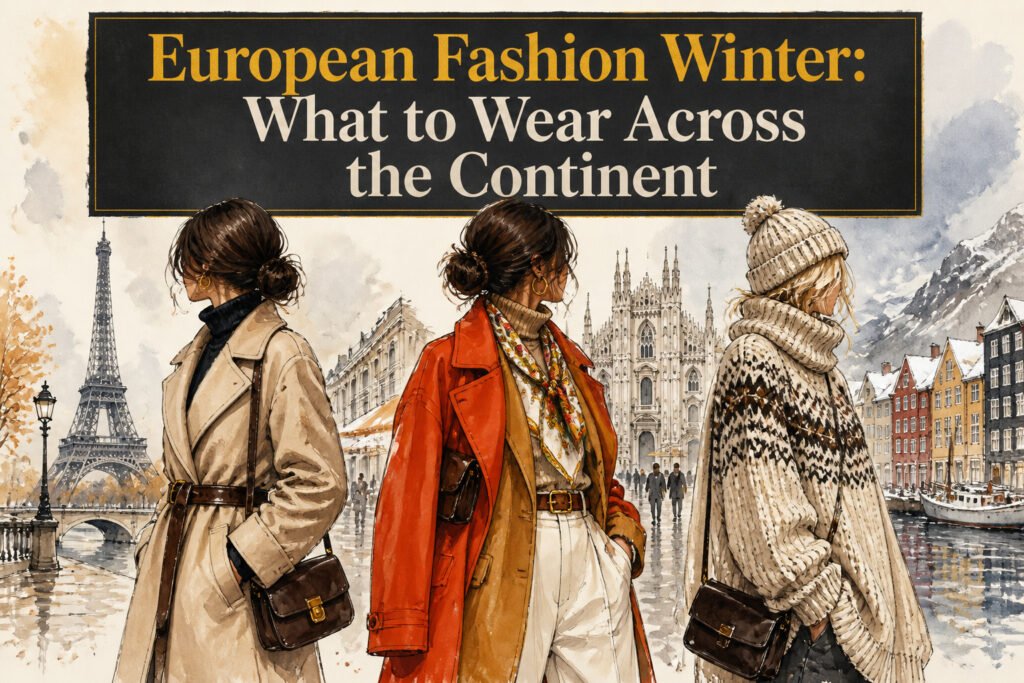
European fashion winter is the practice of dressing for style and function across climates that range from damp Mediterranean chill to sub-freezing Scandinavian freeze. The mistake most travelers make is packing for a single temperature. A fluffy coat cinched with a leather belt, the combination sources flag as one of this season’s defining moves, works in Paris but leaves you exposed in Stockholm.
Fluffy Coat and Leather Belt

Fluffy coats are coming through as one of the biggest outerwear trends this winter, and the way European fashion people are wearing them is worth studying. Instead of letting the volume overwhelm the frame, they’re adding a sleek leather belt to cinch the waist and give the silhouette actual structure.
The belt matters more than you’d think. A fluffy coat without one can read as a shapeless tent on almost anyone; with a leather belt, the same piece suddenly has a waist, a line, a reason. For hourglass or pear shapes, this is intuitive. For rectangles and apples, the belt creates definition that isn’t there naturally. The trick is the contrast: the soft, almost absurd texture of shearling or faux fur against the hard, polished line of leather.
Underneath, a warm knit keeps the look practical, and pointed-toe boots finish it neatly. The sources flag this exact combination as a specific move for the season, not just a general coat trend. If you’re buying one piece to make it work, make it the belt with a ring detail that sets it apart from a standard office style.
V-Neck Knit and Bubble Skirt

The V-neck knit and bubble skirt combination works best when you treat the volume as intentional, not accidental. A belt at the waist adds the structure that keeps the silhouette from reading as costume, and the V-neck does more than you would expect to balance a rounded hemline. I have seen this pairing land beautifully at gallery openings and small-plate dinners where you are seated most of the evening; it fails on walking tours because the skirt rides and shifts with every stride, and there is no fixing that with a different shoe.
Layering matters. Thermal-lined tights are the practical choice for Scandinavian-level cold, but even in milder cities a textured tight underneath, ribbed or cable-knit, extends the outfit into true winter rather than leaving you counting the minutes until indoor heating. For pear shapes, the bubble skirt risks exaggerating what you already carry below the waist; a darker tone there and a lighter or more detailed knit above draws the eye upward. Apple shapes face the opposite problem, and the belt becomes non-negotiable to create definition where the torso otherwise runs straight.
Skip the knee-high boot here. The skirt needs to be the statement, and a boot shaft meeting the hem creates a break that shortens the leg. A heel or loafer keeps the line cleaner.
Wool Blazer, Turtleneck, and Turned-Up Jeans

A wool blazer over a turtleneck with turned-up jeans is the combination I keep coming back to when I need to look pulled together without freezing. The turtleneck does the work of a thermal base layer, that snug roll catching heat at the neck where you lose it fastest. I’ve seen this styled for London and Paris sightseeing, usually with an oversized coat on top when the wind cuts harder.
The blazer needs real weight to earn its place. A lightweight tailored jacket looks sharp in photos but leaves you shivering on actual European streets in January. Look for something you could wear as outerwear for a brisk ten-minute walk without regretting it.
Turning up the jeans changes everything with ankle boots. The cuff creates a clean stop above the boot shaft, so the eye reads your leg as longer and the whole silhouette as intentional rather than apologetic. Without that turn, denim bunches at the ankle and the boot disappears. The sources pair this with leather boots and gloves, smart enough for museum mornings and warm enough for outdoor cafes.
Leopard Coat and Pinstripe Trousers

A leopard coat with pinstripe trousers is the pattern-mixing move that reads as intentional because the two prints operate at completely different scales. The leopard reads as texture from across a room; the pinstripe reads as structure up close. That distance keeps them from fighting.
The coat is where most people stumble into costume territory. What works is a small, dense leopard spot on a mid-weight wool rather than the oversized rosettes that read as 1980s theater. The sources point to European influencers styling this with vivid red shoes, which sounds like a lot until you realize the red becomes the single point of focus that unifies the clash.
For the trousers, a narrow pinstripe spacing wins. Wide-spaced chalk stripes compete with the leopard’s busy ground; a hairline stripe recedes into neutral territory and lets the coat do the work. The sources favor tailored wool-blend cuts for European winter, which makes sense: the fluid drape keeps the pinstripe from going corporate, and the weight holds the line against tights underneath.
I have watched this combination fail when both pieces fight for dominance. The fix is letting one lead. The leopard coat opens over the trousers; the eye registers coat first, trousers second, shoes last. That hierarchy is what separates deliberate from accidental.
Cosy Knit and Tailored Trousers

A cosy knit with tailored trousers bridges the gap between the sofa and a dinner reservation better than most winter pairings. The trick is the weight of the trousers: wool or heavy crepe holds the line of the leg and keeps the look intentional, while suiting-weight fabric goes limp the moment you sit down and looks like you forgot to change after work. I learned this the hard way after a lunch in Lyon where my "smart" trousers looked like pajamas under the restaurant lights.
Tailored trousers are flagged as popular across sources this season, and the pairing works because the knit does all the softening while the trousers do all the structure. A cream jumper with neutral wool trousers and loafers, wool socks visible, reads polished in Milan or Madrid without trying for anything runway-specific. The heavy fabric also means you can rewear them across a trip without them bagging at the knee, which matters more than most packing lists admit.
Trench Coat and Miniskirt

A lined trench over a miniskirt only functions in winter if the knit underneath has real weight. I learned this the hard way in Rome three Februaries ago, where the afternoon sun tricks you into shedding layers you later regret. The trench itself needs a built-in lining or room enough for a chunky sweater; otherwise the gap between hem and hemline becomes a wind tunnel.
Proportion is what makes or breaks this. Knee-high boots close that gap and keep the silhouette from reading as two separate outfits stacked awkwardly. Bare legs or ankle boots leave the look unfinished, like you grabbed the wrong coat on your way out.
This combination works in milder cities: Rome, Barcelona, anywhere winter means damp chill rather than freeze. Paris in late November, maybe, though I’d swap in thermal tights by January. Copenhagen or Berlin demand more coverage than a miniskirt allows, no matter how good the trench. The boots help, but they cannot compensate for fabric that simply is not there.
Cape Jacket, Straight-Leg Jeans, and Knee-High Boots

A cape jacket reads dramatic on the rack and then leaves your arms freezing the second you step outside. The shape needs a fitted knit underneath; anything bulky underneath turns you into a tent. I learned this the hard way in Paris, where the wind cuts straight through the arm slits if your base layer has any gap at all.
Straight-leg jeans balance the volume on top without adding more fabric to fight. Skinny jeans underneath feel mismatched against the sweep of the cape; wide-leg competes with it. The straight cut hits right at the boot shaft, which matters because knee-high boots are the piece that makes this work for actual winter. Leather or suede with a block heel handles cobblestones and snow-covered paths better than anything shorter, and they bridge the gap where the cape stops and the denim begins. I keep waterproof spray in my suitcase now. Without it, salt stains on suede become permanent within a day of city walking.
Oversized Wool Coats

An oversized wool coat only works when the shoulder seam sits below your actual shoulder, not when you have simply sized up. That dropped seam creates the drape without the tent effect, and it is the detail that separates a deliberate silhouette from a mistake.
Length matters more than most people expect. At 5’4", a coat that hits mid-calf cut me in half visually; the hem should land somewhere between mid-thigh and just below the knee for anyone under 5’6". Taller frames can carry the full length, but the coat still needs enough structure through the shoulders to keep the fabric from overwhelming the person inside.
Balance is what keeps you from looking buried. I wear mine with slim trousers or a fitted knit underneath; wide-leg pants underneath an oversized coat require careful attention to proportion or the whole shape collapses into volume without form. A belt helps, though I prefer to cinch the coat itself rather than add one over the top, which reads as trying too hard.
The weight of the wool matters too. Anything lighter than a melton or cashmere blend will not hold that sculptural shape through a day of wear. European winters demand the heavier cloth anyway, so the structure serves two purposes at once.
Chunky Knit Sweaters

The chunky knit sweaters that actually keep you warm in a European winter run heavier than the ones that merely look thick. Alpaca and cashmere blends carry real weight in the hand; a sweater that drapes like a blanket but lifts light is usually hollow-knit acrylic dressed up in beige photography. I learned to check the fabric content tag the way I now check restaurant reviews, after one trip spent shivering through what looked like a substantial cream cable-knit from a fast-fashion rack.
The tuck is where these sweaters live or die. A full front-tuck into high-waisted trousers builds a shelf of fabric at the belt line that reads as pounds gained, not style chosen. The half-tuck, just the front hem angled in at the side seam, keeps the vertical line intact. For a cleaner waist, I tuck only a fist-width of the center front and let the sides hang. The sweater should hit at mid-hip or below; anything shorter fights the proportions and rides up with movement.
& Other Stories does a brown-grey neutral that layers well under coats without the bulk that makes you choose between warm shoulders and a jacket that buttons. COS offers a similar beige shape in a tighter gauge that reads more office-appropriate. If the budget is tighter, NA-KD’s version in the same tone works for the café days when the coat comes off and the sweater has to carry the outfit alone.
Leather Jackets

A leather jacket only earns its place in a winter lineup if the lining does the heavy lifting. Shearling, real or faux, changes the piece from a fall impulse buy into something that actually holds heat. Without it, the jacket becomes a mid-layer under a wool coat, which works fine in Milan or Lisbon where winter rarely drops below 40°F but leaves you miserable in Berlin or Warsaw once the wind picks up.
The cut matters as much as the lining. Room in the shoulders and chest for a chunky merino or a thin cashmere turtleneck underneath lets you adapt as temperatures swing. I look for styles that close easily over a substantial knit without pulling across the back; otherwise you end up choosing between the jacket and the sweater, not wearing both.
A leather jacket with shearling lining and space for real knitwear underneath will carry you through winter in southern European cities. Head north or into the Alps and it becomes a layer, not your outer defense. That distinction is worth deciding before you pack, not when you are shivering outside a tram stop in Prague.
Knee-High Boots

Knee-high boots do the structural work in a winter outfit that ankle boots simply cannot. The shaft hits just below or at mid-calf, which means the height of the boot relative to your calf muscle is what determines whether the silhouette reads as polished or off. Too tight against the widest part of the calf and the line breaks; a finger or two of ease keeps the shaft sitting clean over leggings or slim trousers.
For all-day city walking on European cobblestones, a block heel between one and two inches is the practical ceiling. Higher than that, and the uneven stone becomes an ankle threat by hour three. Leather or suede uppers with a treated or naturally water-resistant finish handle the damp better than raw suede, though waterproof spray is worth the extra step before you pack. One pair in black leather and one in dark brown suede covers most winter trips; if space forces a choice, black leather wins for versatility from museum mornings to dinners out.
Tailored Trousers

Wool-blend tailored trousers carry a winter trip in Europe better than almost anything else in the bag. The fabric weight matters: too light and the wind cuts through on a Copenhagen afternoon, too heavy and you are sweating through a Milan gallery lunch. A proper wool blend hits the middle, structured enough to read polished, warm enough to skip the long underwear.
Rise is where body shape actually comes into play. Low-rise cuts from labels like Reformation sit lower on the hip and work for narrower frames; mid-rise options from Frankie hold the waist where most of us want coverage after a morning pastry. Mid-rise wins for anyone carrying weight through the middle, since it creates a clean line without the muffin effect that low-rise invites when you tuck in a knit.
Boots versus sneakers changes the hem. A full-length trouser breaks cleanly over a knee-high boot, but the same pant pools and drags with sneakers. Cuff or crop for trainers, or buy two lengths if the trip mixes cities. Black, beige, and a third neutral cover every combination; gray from Aritzia is the specific pair sources keep coming back to for days when nothing else coordinates.
Puffer Jackets

Fill power is the number that actually matters when you’re staring at two puffers and guessing which one works for Helsinki. It measures how much space one ounce of down occupies in cubic inches; 600 is decent, 800 is serious, and anything below that will cost you in bulk or warmth. The Aritzia Super Puff comes in both long and cropped lengths, with matte and glossy finishes, and that variety matters because the long version reads statement piece, the short one reads everyday — your call based on what else is in your bag.
A puffer can still look deliberate rather than slept-in. The fix is structural: slim-fit bases underneath, nothing flared or layered underneath that competes for volume. I learned this the hard way in Berlin, where December temperatures sit at 34–41°F and January drops below freezing. At the Christmas markets, the women who looked pulled together wore the same coat technology as the tourists who looked like sleeping bags; the difference was proportion, not price.
Sweden demands even more honesty about insulation. Stockholm in December averages 30–37°F, January and February go lower, and the Scandinavian approach is minimal but genuinely warm — not a fashion coat, a functional one. Neutral palettes help, but the coat has to handle snow and the very short days when you are outside longer than planned. Waterproofing and grip on your boots matter as much as the fill power number, because ice is the detail that ruins a trip.
Textured Tights

A pair of ribbed or cable-knit tights turns a skirt you already own into a winter outfit instead of a summer memory. The texture itself is doing the work, so you do not need a bold pattern to get the point across. I look for 80 to 100 denier for actual warmth in a European December; anything below 50 is a styling layer, not a thermal one. Floral or lace tights read vintage and pretty, though in practice I find them harder to style than a fine rib that disappears into boots. Black patterned tights add interest without the commitment of red, which can feel like a costume if the rest of the outfit is not equally decisive. Knee-high boots cover the transition and keep heat around the calf, which is where thin tights always fail first. For Scandinavia or a particularly bitter week, thermal-lined tights exist and extend the same skirts by another full month.
Classic Trench Coats

A trench coat in winter only works if you commit to the liner. The cotton shell you see in April does nothing against a Berlin wind, which is why European brands sell versions with wool or padded liners buttoned in separately. Without one, you are wearing a water-resistant dress.
The belt placement changes everything. Tightening it at the natural waist gives shape through bulky layers; letting it hang or buckling it loose turns the coat into a tent. I learned this the hard way in Vienna, layering a sweater and a blazer underneath and wondering why every photo looked like a bathrobe.
An unlined trench is a different garment entirely. It skims the body, moves with you, and makes sense over a blouse in September. The winter version has to accommodate a liner plus whatever you are wearing, so the shoulders sit wider and the sleeves need room to roll. Size for the layers, not for the frame.
Versatility is the payoff. The same coat works over a cocktail dress or jeans depending on where you set the belt and what you put underneath. That is why it survives in a packed suitcase when other coats stay home.
Statement Outerwear

In Paris or Vienna, your coat is often the only visible part of your outfit for hours at a time. A bold color, faux fur texture, or quilted cut does the heavy lifting that a neutral coat simply cannot. I reach for statement outerwear about one day in three on a winter trip; the rest of the time, an oversized wool coat in camel or black handles the work of blending in.
The mistake I made early was packing two statement coats and nowhere to put them indoors. Restaurants, museums, and even some cafés in European cities rarely offer spacious coat checks. A bulky faux fur number becomes a lapful of fabric through a three-course dinner. One statement piece, chosen deliberately, is the practical limit for a winter capsule.
Belted wrap coats solve part of this. They read as feminine and intentional without the volume that demands its own chair. Faux leather in burgundy or baby pink works the same way: visible presence, less bulk than fur. For travel storage, I wear the statement coat onto the plane and fold the neutral wool into my carry-on. The bulky item stays on your body, not in your bag.
Layered Accessories

A wool scarf, leather gloves, and a beret make up the accessory core that actually gets worn. The sources split on headwear: one recommends a beanie or knit hat for pure warmth, another names the beret as the Parisian-leaning choice. Cold ears settle that debate fast, so pack both if your week includes outdoor sightseeing.
For scarves, one warm, ideally blanket-style piece doubles as airplane wrap and daily layer. A single quality scarf outperforms three thin ones competing for suitcase space. Glove material matters less than function; touchscreen-friendly fingertips save you from pulling gloves off at every metro map. Mittens win on warmth, gloves win on utility, and the compromise is a slim-lined glove you can actually operate a phone in.
A compact umbrella and sunglasses round out the list. Winter sun on snow blinds more than people expect, and a secure zip crossbody keeps hands free for coffee or handrails.
Thermal Base Layers

Thermal base layers are the piece most outfit roundups skip entirely, which is strange because they determine whether the rest of your look reads polished or bulky. The difference between a thermal and a regular long sleeve top is real: purpose-built base layers trap heat without the weight, and under a thin knit in a Copenhagen café or a Stockholm gallery, that matters.
Merino versus synthetic is the first decision. Merino wool regulates temperature and resists odor between washes, which is why the Unbound Merino Crew Neck gets packed so often for winter Europe trips. Synthetic options run cheaper, and one source found a thermal top under $25 that held up to regular use, but merino wins for repeated wear without smelling like a gym bag by day three.
The real test is laundering. Merino survives skipping washes; synthetics need one after each wear but dry faster in a hotel sink. Both should read invisible under cashmere or a fine-gauge sweater. If the base layer shows ridges at the sleeve or neck, the fabric is too heavy for the outfit.
For Norway-level cold, or any trip averaging below freezing, thermals are not optional. They are the foundation the rest of the stack builds on.
Waterproof Footwear for City Days

Waterproof leather boots are the one item I would not pack for a European winter without. Cobblestones stay slick long after rain stops, and the salt used on city sidewalks in Berlin or Vienna eats through untreated leather in a single season. A rubber lug sole with visible tread pattern grips wet stone far better than the flat soles that look fine in a hotel mirror. I learned that the hard way in Prague, watching a woman in heeled boots slide sideways on a tram platform.
Ankle height handles daily city walking and pairs cleanly with jeans or trousers. Knee-high boots add warmth for colder destinations and work with dresses or skirts, though they are harder to pull on and off during long travel days. Chelsea boots in waterproof leather hit a useful middle ground: sleek enough for dinner, practical enough for puddles.
The maintenance is non-negotiable. Salt stains set within hours and crack leather by spring. I wipe mine down every evening with a damp cloth and condition weekly when I am traveling through cities that salt heavily. Skip this and you are buying a replacement pair by February.
Capsule Packing for Winter Europe

A carry-on weight limit forces the real editing. Last winter, I planned for twelve pieces across seven days and still left a chunky cable-knit behind at the hotel in Prague; the merino crew neck from Unbound Merino did more work, regulating temperature and resisting odor between washes while taking a fraction of the space.
The arithmetic runs on invisible foundations. Three bottoms, four or five tops, and an optional dress already generate more combinations than most travelers wear, but the thermal base layer is what makes it possible in minus five on a tram. Worn under regular clothes, it adds more warmth than that abandoned sweater and sits in a fraction of the space.
Packing cubes plus a personal bag or daysack keep it all in a carry-on suitcase, though the real discipline is re-wearing and possibly doing light laundry. The formula stays leaner than most expect because the thermal does the heavy lifting; without that invisible layer, the bag swells fast.
Regional Weather Realities

Winter across Europe is not one season but several, and the mistake most travelers make is packing for a single temperature zone. Barcelona in December sits at 9–14°C (48–57°F), mild enough that a merino sweater over a long-sleeve tee and dark jeans handles most days. Meanwhile Prague or Kraków stay between -2°C and 5°C (28–41°F), dipping below freezing at night, where that same outfit would leave you shivering through a Christmas market.
The Mediterranean rewards a medium-weight waterproof jacket; the Nordic demands a thick down coat, fleece leggings, and proper thermals. Southern Spain’s Costa del Sol is genuinely pleasant in winter, but northern Bilbao is cool and rainy at 10–14°C (50–57°F) — same country, different wardrobe entirely.
Indoor heating adds another variable. In much of Northern and Eastern Europe, cafes and museums blast dry heat that leaves you sweating through a chunky knit you needed five minutes ago on the street. A thermal base layer becomes the invisible workhorse here: it adds more warmth than a bulky sweater and strips down small once inside. The capsule stays leaner than most travelers expect when the foundation layer does the heavy lifting.
What I Got Wrong in Copenhagen

Copenhagen in January taught me that temperature ratings on a coat tag do not tell you what walking two miles against a wind off the Baltic feels like. I had packed a wool cocoon coat, the kind that photographs beautifully for coffee-shop sits, and paired it with leather gloves I already owned. Within twenty minutes of stepping out of my hotel, the wind had found every gap. My hands went numb. The coat’s single row of buttons let gusts straight up the front.
I bought a replacement at a shop near Nørreport station: a black down parka with a two-way zipper, storm flap, and cuffs that sealed tight. It cost about $180. The difference was immediate. That evening I walked the same route to dinner and stayed warm enough to notice the street lamps reflecting off the canal, which the morning before I had missed because I was counting blocks until I could get inside.
The leather gloves went in the suitcase and did not come back out. Lined wool mittens from the same shop, $35, handled the wind better because mittens let fingers share heat. That was the real lesson. Wind matters more than the number on the thermometer, and the right seal at wrist and waist matters more than how the coat looks in a still photo.
Frequently Asked Questions
What should I wear in Europe in winter?
Layering is the foundation: a thin thermal base layer, a warm knit, and a structured coat handle everything from freezing mornings to heated restaurants. Europeans favor muted, classic tones like black, camel, cream, and navy that mix easily and photograph well against winter backdrops. Quality outerwear matters most, since your coat is often the only visible part of your outfit for hours at a time.
What are the best winter shoes for Europe?
Knee-high boots are the most versatile choice, with a block heel between one and two inches for cobblestone walking. The shaft should hit just below or at mid-calf with a finger or two of ease against your calf muscle so the line stays clean. Leather or suede with a water-resistant finish handles damp streets; waterproof spray before you travel protects against salt stains.
How do I pack for winter in Europe?
Build a capsule wardrobe around three bottoms, four or five tops, and one optional dress, with thermal base layers as the invisible foundation. A thermal base layer adds more warmth than a chunky sweater and takes up a fraction of the space. Focus on pieces that layer and mix: oversized wool coat, chunky knits, tailored trousers, and one statement coat worn onto the plane to save luggage space.
What are the essential winter fashion items for Europe?
The core pieces are an oversized wool coat with real weight, chunky knit sweaters in alpaca or cashmere blends, and wool-blend tailored trousers that hold their line. Add a puffer with 600+ fill power for northern cities, textured tights at 80 to 100 denier for skirt days, and a lined trench with a separate wool or padded liner for milder, wetter cities. One warm blanket-style wool scarf and touchscreen-friendly leather gloves complete the kit.
How do I stay warm in winter in Europe?
Thermal base layers trap heat without bulk and let the rest of your outfit read polished rather than puffy. Merino wool regulates temperature and resists odor between washes; synthetic alternatives work too. Over that, a turtleneck catches heat at the neck where you lose it fastest, and a coat with real structure, not just style, earns its place against January wind.