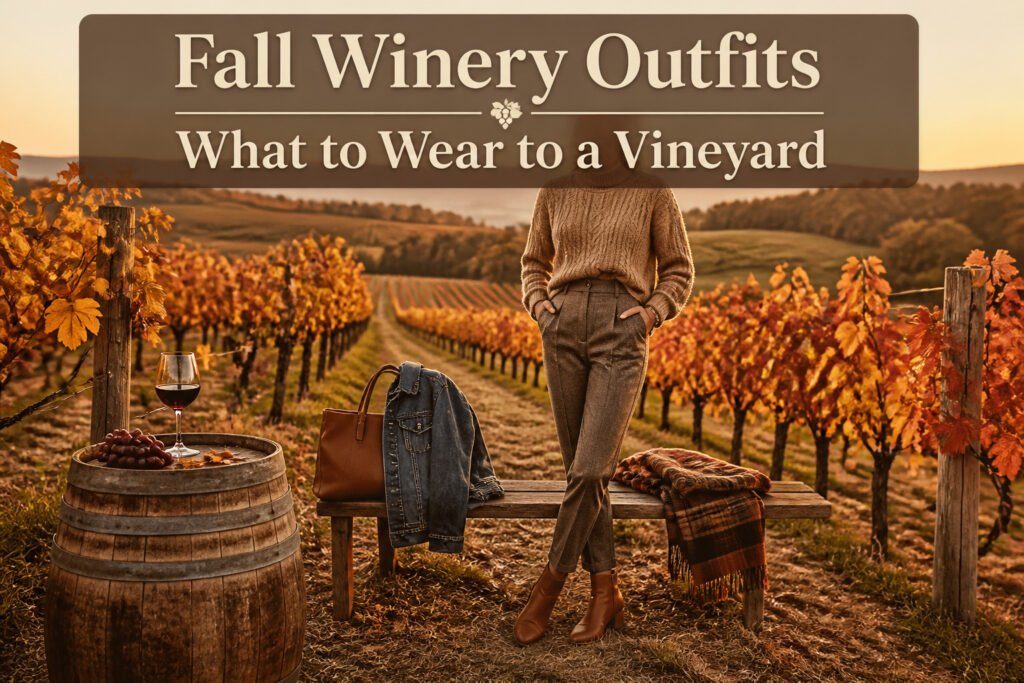
Fall winery outfits are clothing combinations built around the temperature gap between chilly vineyard mornings and warm tasting rooms, with footwear stable enough for gravel crush pads and grass between rows. The pairing that came up most often across the sources is a mid-weight wool knit sweater with tailored stretch wool trousers, finished with ankle boots and a denim or leather jacket you can strip off once the afternoon warms. What trips most people up is heel height: anything over about one and a half inches sinks and wobbles on loose gravel, and thin soles leave you shifting weight on cold concrete tasting-room floors after twenty minutes.
Knit Sweater and Tailored Trousers
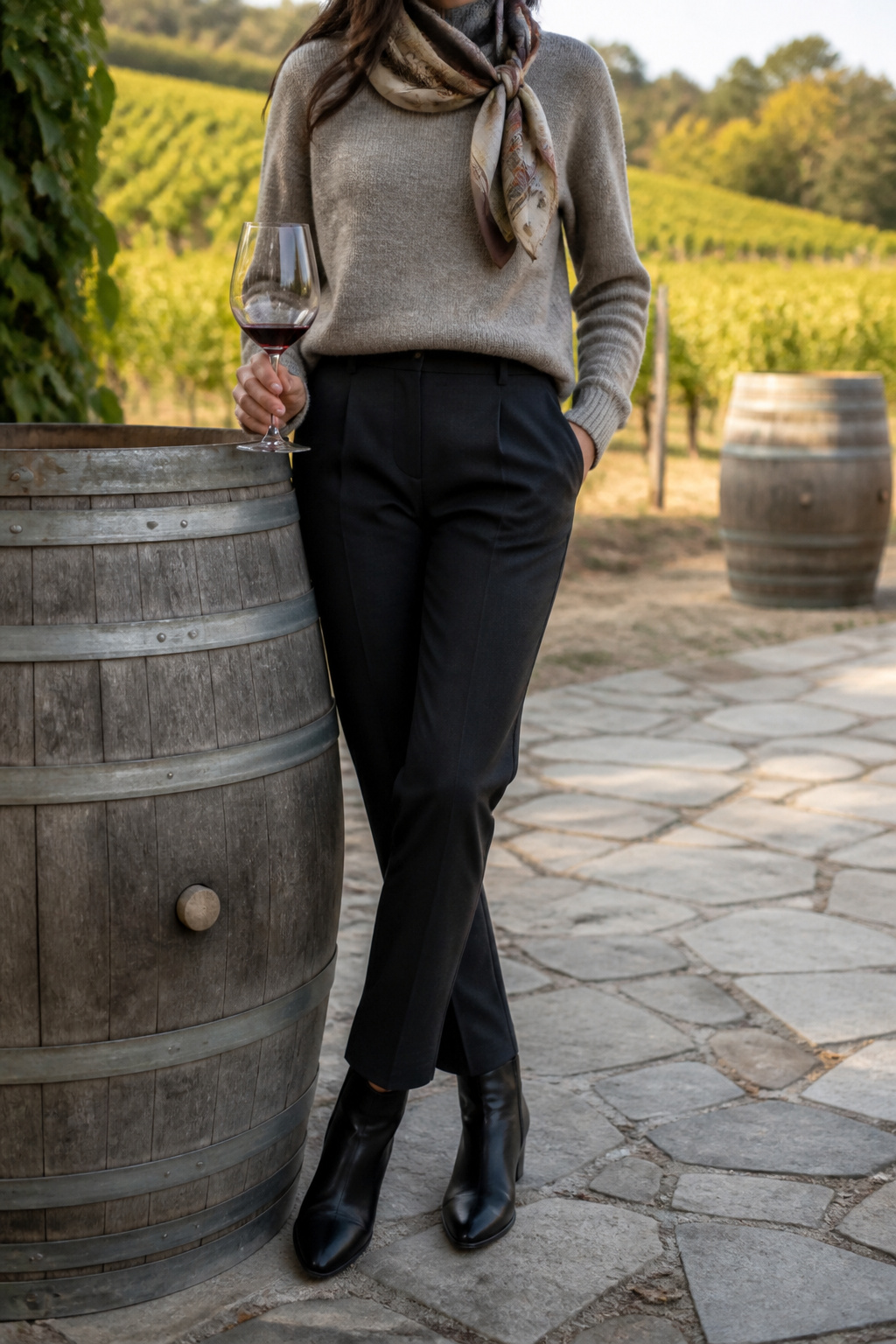
A knit sweater with tailored trousers is the pairing that came up most often across the pages I read, and the logic holds up. The sweater handles the temperature gap between a chilly vineyard morning and a warm tasting room, while the trousers signal you thought about the day without looking like you tried.
A mid-weight wool or cotton-blend knit works for September; by November, a chunky cableknit or cashmere layer makes more sense. Sources mentioned silk foulards as a finishing touch, which reads as dressed-up in a way that jewelry does not.
For fabrics that travel well, stretch wool trousers hold their shape through multiple stops better than linen blends or anything with a high linen content. The Nala Stretch Pants and similar styles with a bit of give keep you presentable if the itinerary shifts from tasting to lunch to a barrel-room tour. Ankle boots finish the look, and a denim or leather jacket on top covers the gap if the afternoon turns cold.
Sweater Dress and Boots
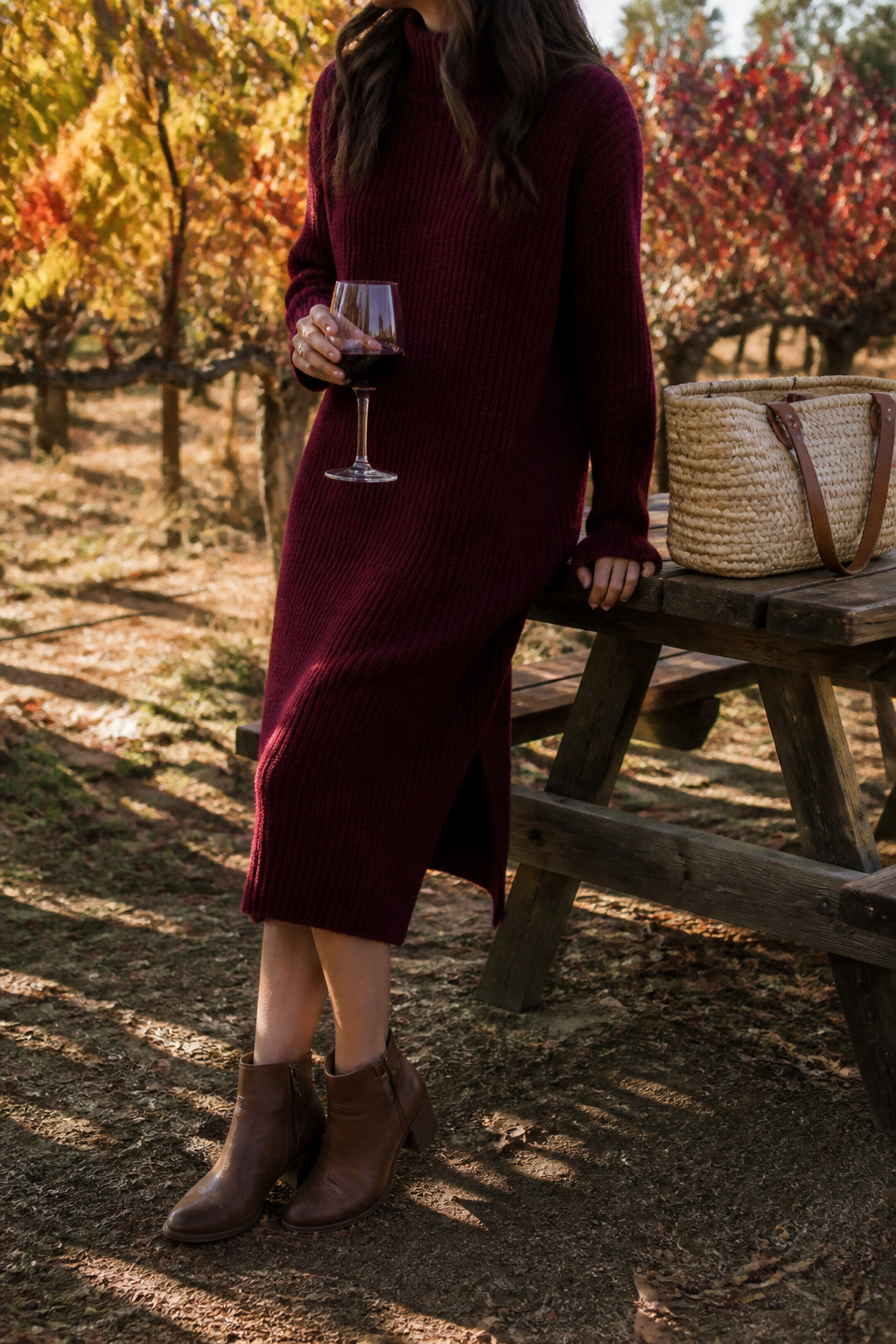
Boot shaft height matters on gravel more than most people expect. A low heel, even a kitten heel, will drive you crazy between the rows; the uneven ground twists your ankle with every third step. I reach for ankle boots with a low heel underneath dresses, or cowboy boots if I want the look to feel current. The heel stays under two inches, and the sole has some grip.
Sweater dress length decides whether you can sit on a picnic table or low stone wall without tugging fabric back into place. A midi or maxi length gives you coverage to stand up normally; anything shorter and you’re adjusting every time you shift. I learned this the hard way with a dress that hit mid-thigh, fine for brunch, wrong for vineyard rows where you’re up and down tasting and touring.
The afternoon warming up is the other half of the mistake. A mock neck knit that felt perfect at 10 a.m. traps heat by 2 p.m. Leave the neckline room to breathe, or bring a hair tie you can use to scoop the neck up off your collarbone when the sun finally breaks through.
Maxi Dress with a Leather Trench
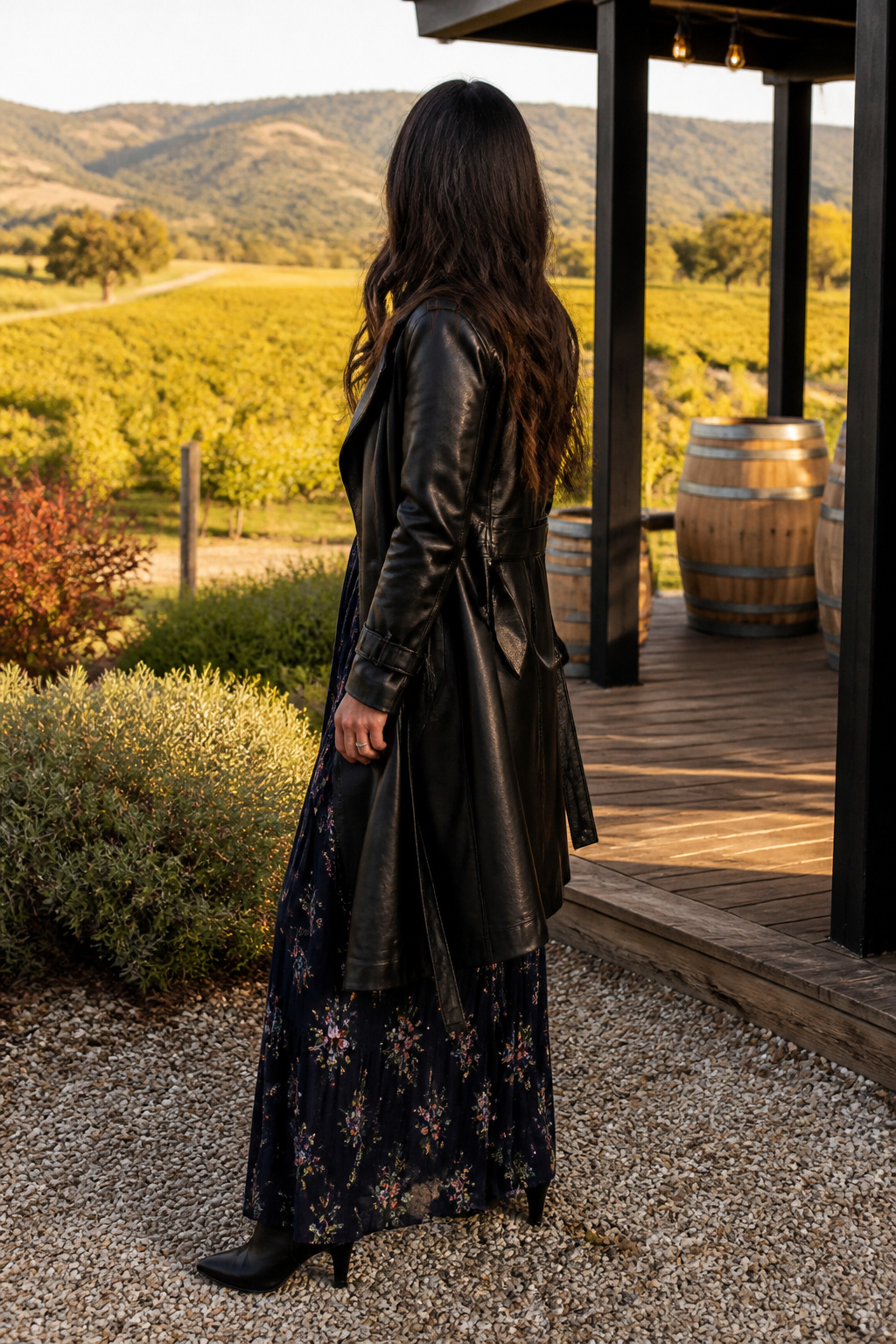
A maxi dress at a vineyard sounds romantic until the wind kicks up across open rows of vines. The skirt billows, you spend the afternoon clutching fabric, and the whole look collapses into fuss. A leather trench changes that equation. It adds weight and structure without the bulk of a wool coat, and the longer line keeps the silhouette intentional rather than swallowed.
Shoe weight matters here more than you’d think. A heavy boot anchors the volume of a long skirt; something too light, like a ballet flat or a slim heel, leaves the bottom half looking unbalanced. Ankle boots hit the right midpoint, sturdy enough to ground the look but not so chunky they fight the dress.
The real hazard is wet grass after morning dew. A maxi hem soaks it up fast, and you end up with damp fabric clinging to your calves for hours. The practical fix: a midi length if the forecast is cool and damp, or a maxi you are willing to hold slightly above the ground when walking between rows. A leather trench won’t solve that part, but at least the top half stays polished.
Midi Pleated Skirt and Knit Top Set
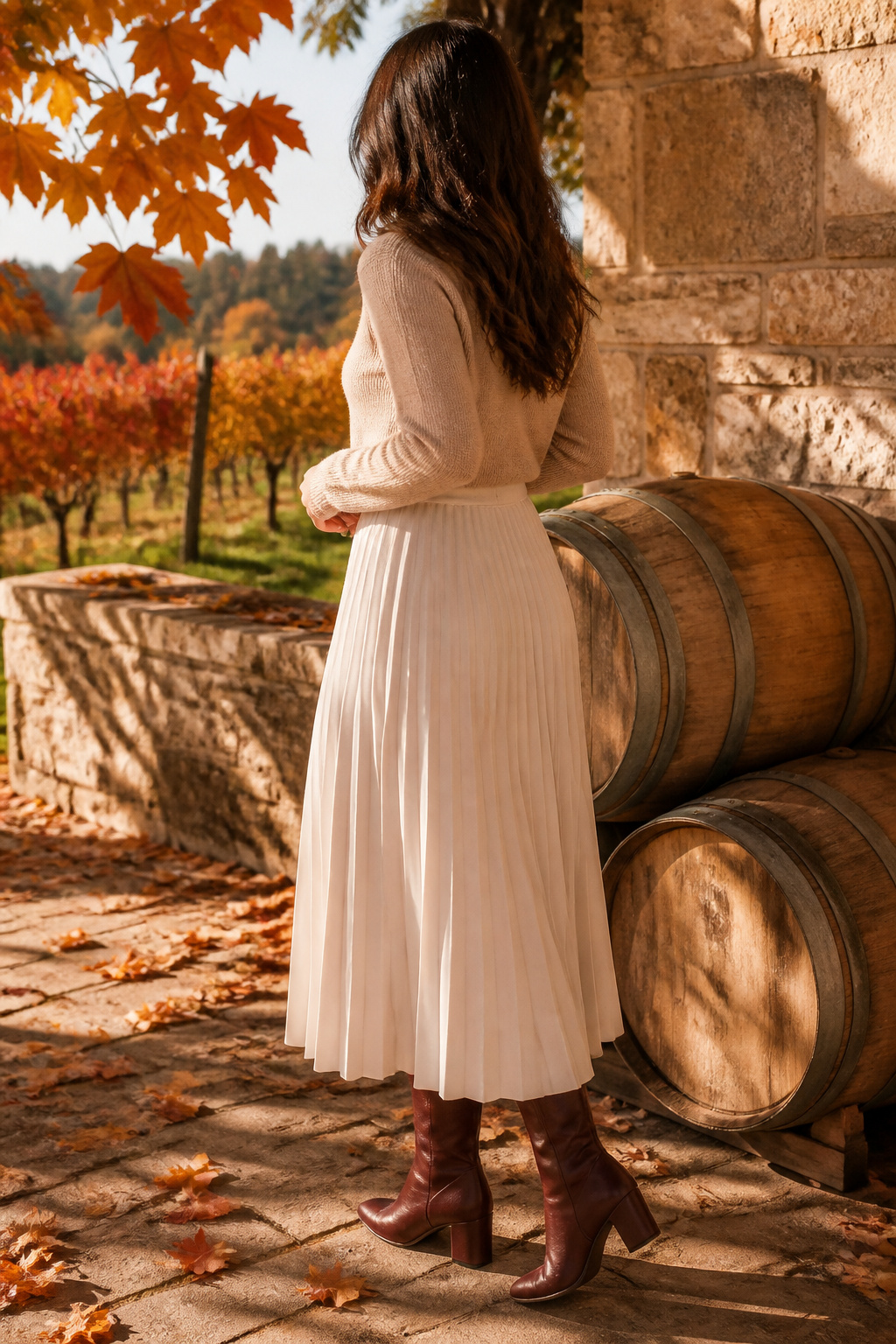
A pleated midi skirt with a matching knit top lands somewhere between intentional and accidental, and that tension is what makes it work for a winery. The set reads polished in the parking-lot photos, but the separates split apart easily if the afternoon warms up or the knit starts to feel too formal next to picnic-table seating. Tuck the top fully into the waistband before you sit down for the tasting; a half-tuck collapses against the pleats and bunches in photos, and you will not want to adjust it between courses.
The waistband itself matters more than the pleats do. A mid-rise band that sits at your natural waist leaves room for the shift that happens during a multi-course pairing menu. Low-rise cuts slide and fight the skirt’s volume; high-rise can feel like armor after the third pour. Pleat retention after an hour in a tasting-room chair varies by fabric weight, but heavier knits with stitched-down pleats at the hip hold their line better than lightweight accordion styles that flatten where you sit.
Against fall foliage, this combination reads as texture rather than color. The vertical lines of the pleats pick up the vertical trunks behind you, and the solid knit grounds the movement so the whole outfit does not compete with the leaves. Calf-high boots finish the line without cutting the leg the way ankle boots do, and minimal jewelry keeps the pleats from feeling busy. If the set feels too matched, swap the knit for a tonal cousin: same family, not identical.
Wool Short Coat and Long Sleeve Top
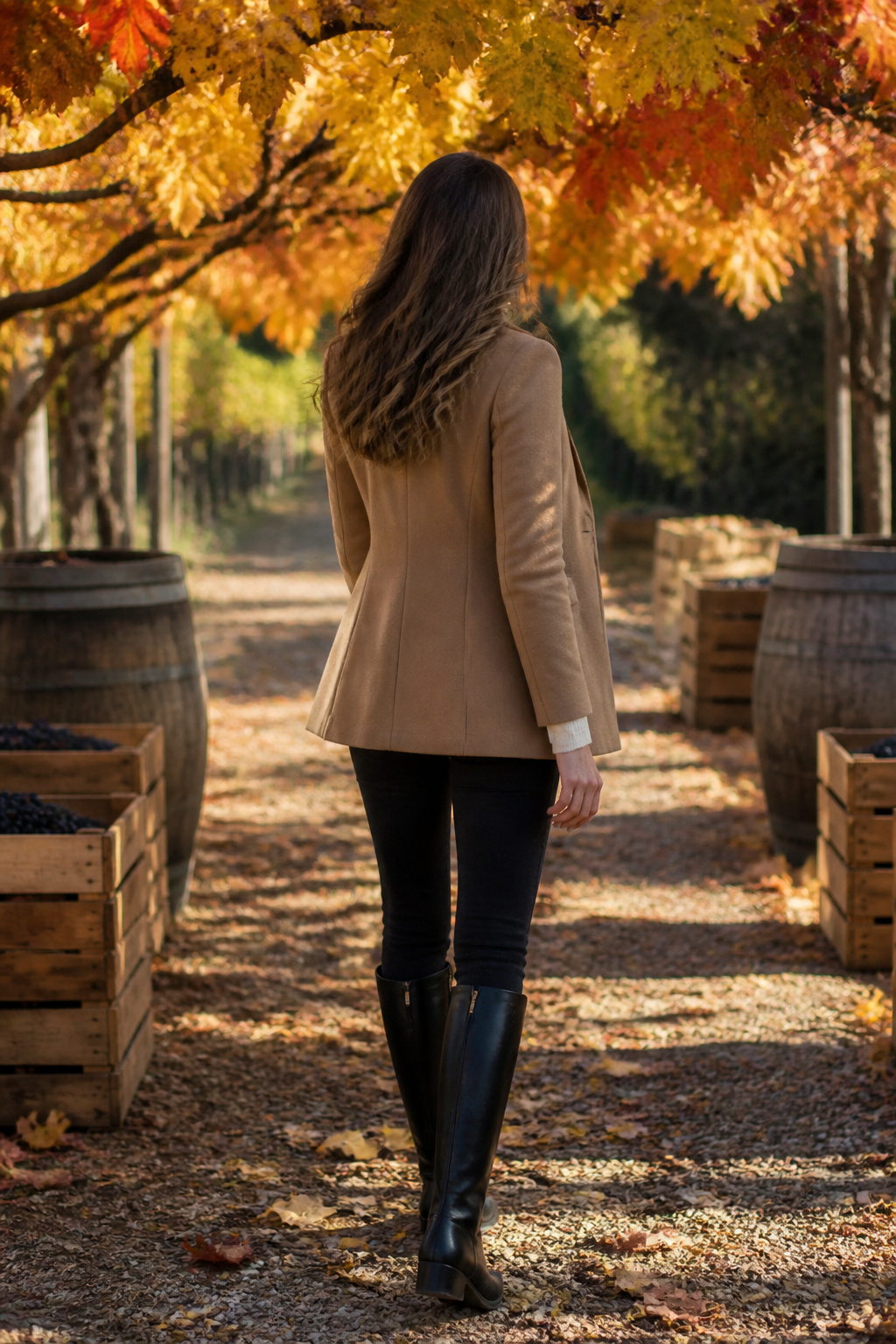
A wool short coat hits at mid-hip to upper thigh, which matters more than most people think for a day that moves between gravel crush pads and indoor barrel rooms. That length keeps fabric clear of machinery and wet grape skins outside, then lets the coat come off without blocking narrow aisles once you step into a tasting room where the thermostat sits at cellar temperature or above.
The fabric weight tells the rest of the story. A standard wool short coat runs 12–16 ounces per square yard, heavy enough to cut wind on exposed hills but lighter than the 24–32 ounce melton wool of a full winter overcoat. At 12–16 ounces, it folds to something you can actually carry or drape over an arm for an hour indoors without the bulk becoming its own problem.
Layering under it needs the same logic. A fitted long sleeve top in a neutral shade, cotton or a fine merino, gives warmth without competing for space under the coat’s closer cut. The sources split on sleeve length: a standard long sleeve for predicted cool, or three-quarter if the afternoon is forecast to warm. Two ways to play this: keep the top lightweight and plan the coat as outerwear that stays on, or size the coat slightly roomier and treat the top as a layer you might strip to if the barrel room runs warm from fermentation activity.
The coat’s pattern does the styling work. A solid camel or burgundy reads polished against vineyard rows; a subtle plaid pairs back to dark jeans or tailored trousers without needing another statement piece. Riding boots finish the line cleanly and handle uneven ground, though any boot with a low stacked heel and enough tread will do the practical work. The old-money feel some sources mention comes from proportion, not price: the short coat’s structured shoulder against slim pants, the boot shaft hitting just below the coat hem.
Jeans and a Cardigan

The casual baseline that still photographs well starts with the right denim wash. Darker rinses read as evening-ready without effort, while a true black pair like Paige’s most flattering cut handles the tasting-to-dinner shift without the costume-change problem. A boyfriend cardigan gives that relaxed, comfortable fit, but length matters for photos: anything that hits past mid-thigh starts to swallow your frame in group shots against the vines. Cropped styles or those that stop at the hip keep proportions clean.
Striped cardigans offer a preppy, polished look that elevates the pairing without abandoning its comfort. For footwear, ballet flats keep toes covered and warm for fall, though booties add edge if the evening turns cool. The real strength of this combination is how it builds: start with a simple long-sleeve base, add the cardigan for afternoon warmth, and swap in a denim or leather jacket if temperatures drop before your dinner reservation. The layers do the adapting so the outfit does not have to.
Leather Jacket and Jeans
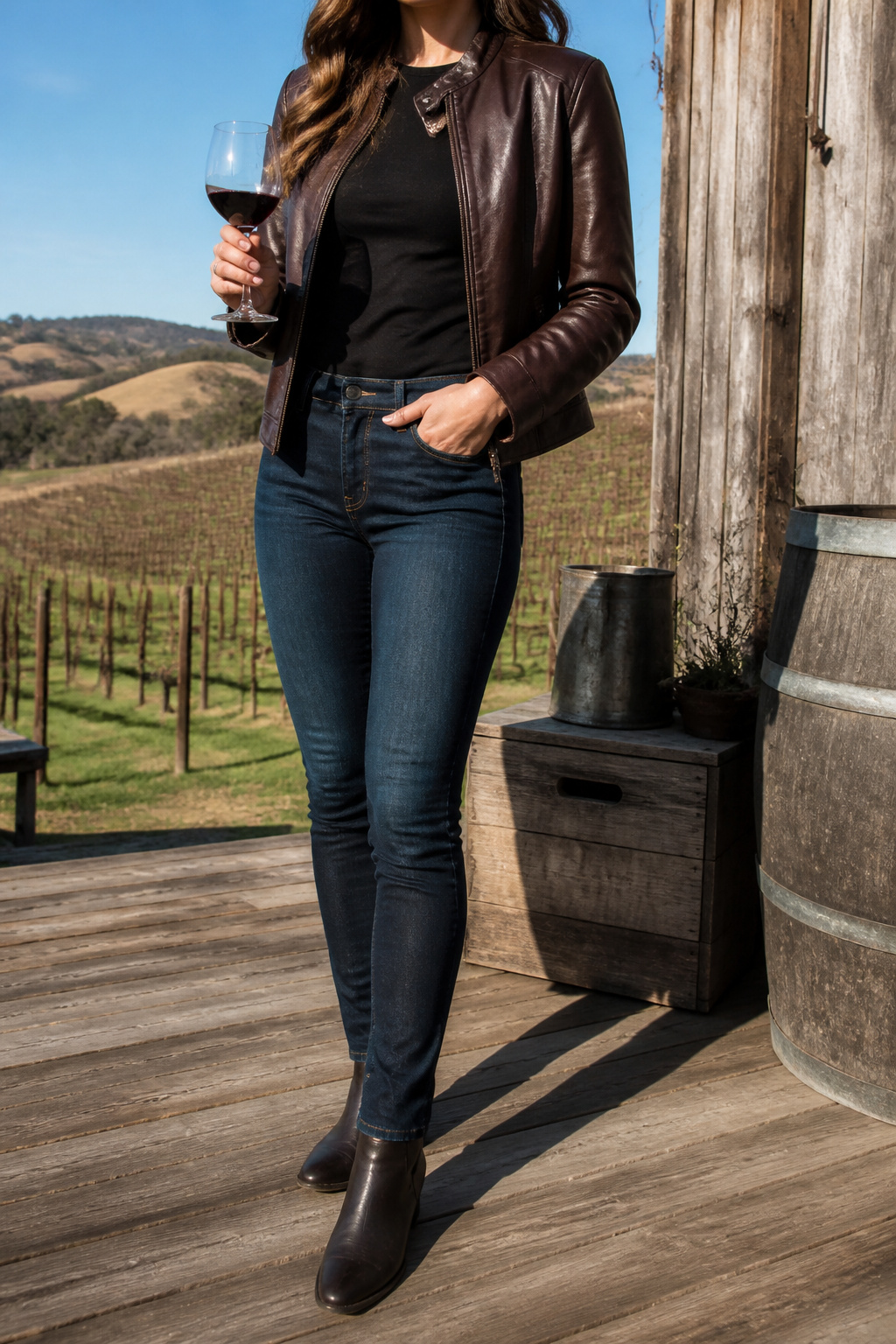
A midweight leather jacket carried me through a Sonoma afternoon that started at 62°F and slid to 48°F by sunset. That weight matters: anything heavier than roughly three to four ounces and you’re fighting the jacket across a picnic table or while reaching for a glass. Anything lighter, and the wind cuts straight through once you hit the breezy rows between vines.
The cut tilts the whole look. A cropped moto reads too edgy against weathered barn wood and rolling hills; it can feel like costume. A longer, straighter silhouette or a slightly boxy trucker cut in leather lands closer to refined without trying for dressy. The sweet spot sits just below the hip, with clean shoulders and minimal hardware.
Direct sun is where leather becomes a problem you didn’t plan for. On an outdoor tasting patio, the material absorbs heat fast and holds it. Within twenty minutes the jacket goes from comfortable to clammy against your back, and the smell of warmed hide turns noticeable in a way nobody wants to be. Shade or a lighter layer underneath solves it, but planning for both sun pockets and cellar cool is the move that saves the afternoon.
Denim Dress and Stiletto Boots
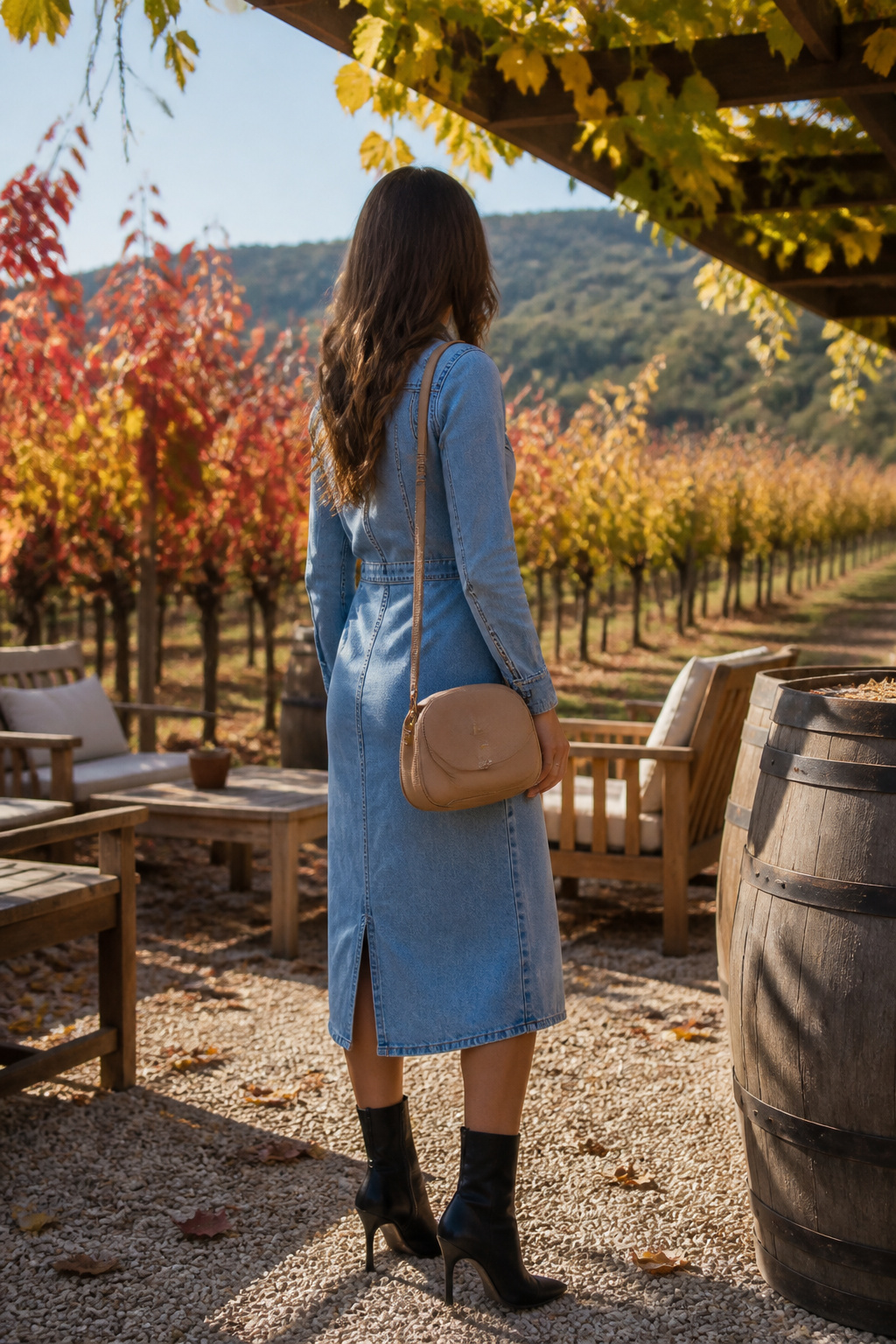
A denim dress with stiletto boots barely registers in the outfit roundups, and that scarcity is itself a warning. The sources that do mention it, like the denim mini dress paired with suede boots for California vineyards, are banking on flat ground and mild weather. Most winery terrain is neither. Gravel lots, uneven grass between rows, and wooden decks with gaps between boards turn a thin heel into a liability. The sources are blunt about this: heels are not your friend when visiting a winery, and the advice to stay away from high heels or a pair of wedges gets repeated for a reason.
If you are set on the combination, a midi length saves the look from the "forgot my pants" effect that hits shorter denim dresses. The sweet spot sits at or below the knee, where the dress reads as intentional rather than unfinished. Stiletto boots work only when your day is limited to the tasting room and paved paths; the second you step onto vineyard rows, the heel sinks or wobbles. Suede boots add a warm touch and make this outfit suitable for both indoors and out, but that warmth applies to the material, not the heel height. For the actual walking, the sources favor cowboy boots, ankle booties, or knee boots with a block heel or flat sole.
Turtleneck with a Denim Skirt
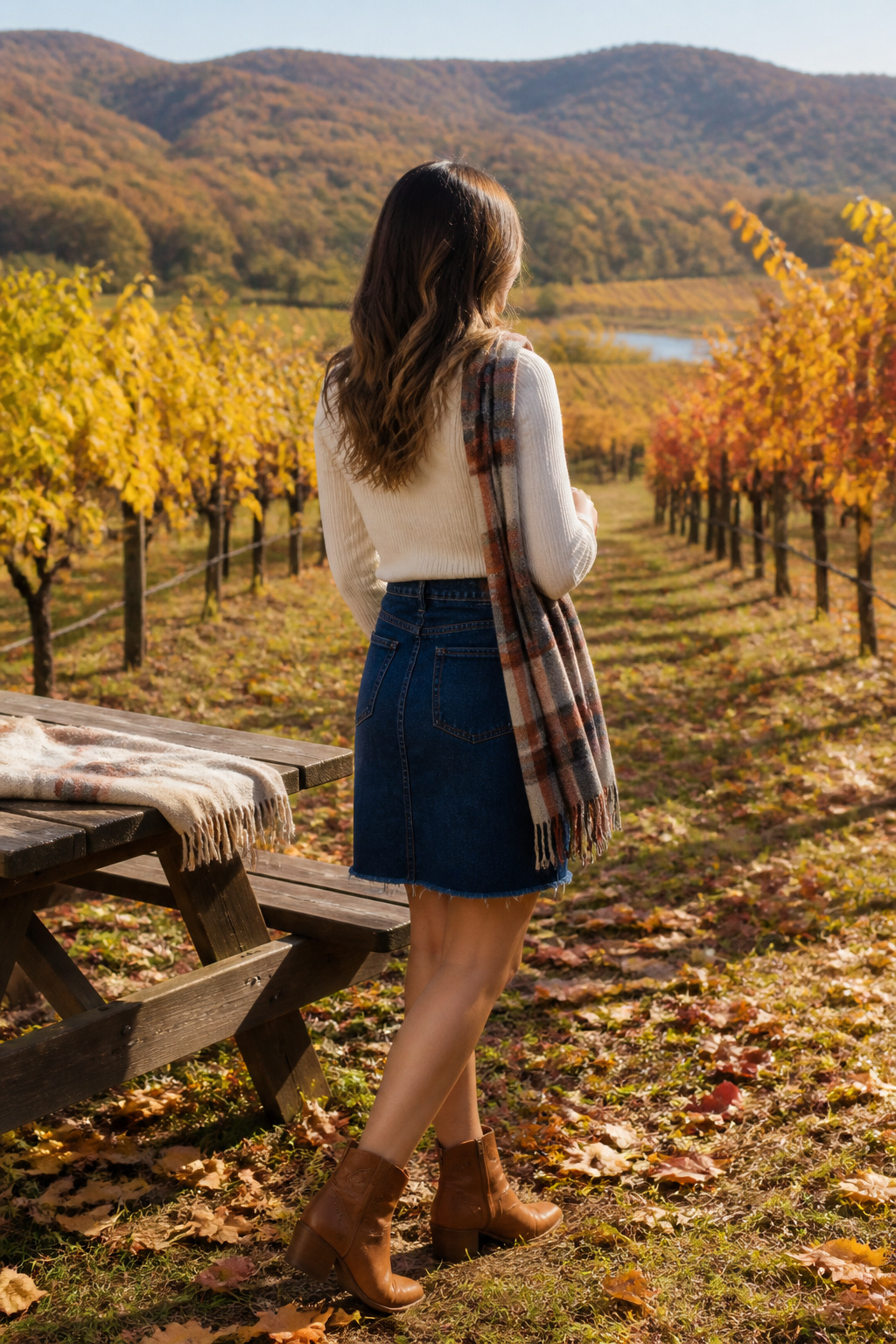
A mock-neck knit with a denim skirt lands in a tricky middle ground for fall winery outfits: the neck adds warmth, but skirt length decides whether you can sit down at a picnic table without thinking about it. Alicia Tenise skips minis entirely for unreserved tastings because standing up from low lawn chairs or the ground gets awkward fast, especially once the wine is poured. A midi or just-above-the-knee cut fixes that, though the pairing still fights the afternoon temperature swing. Strawberry Chic styles this with western booties for the rustic effect, which works until a 70-degree afternoon hits and the turtleneck becomes too much. The move is a lightweight, breathable base layer you can shed: start with a thin long-sleeve or a fine-gauge knit that tucks cleanly, then add the chunkier sweater only if the morning stays cold. Denim gives the structure; the neck height and the hemline are what keep you actually comfortable through the tasting.
Statement Piece Combinations
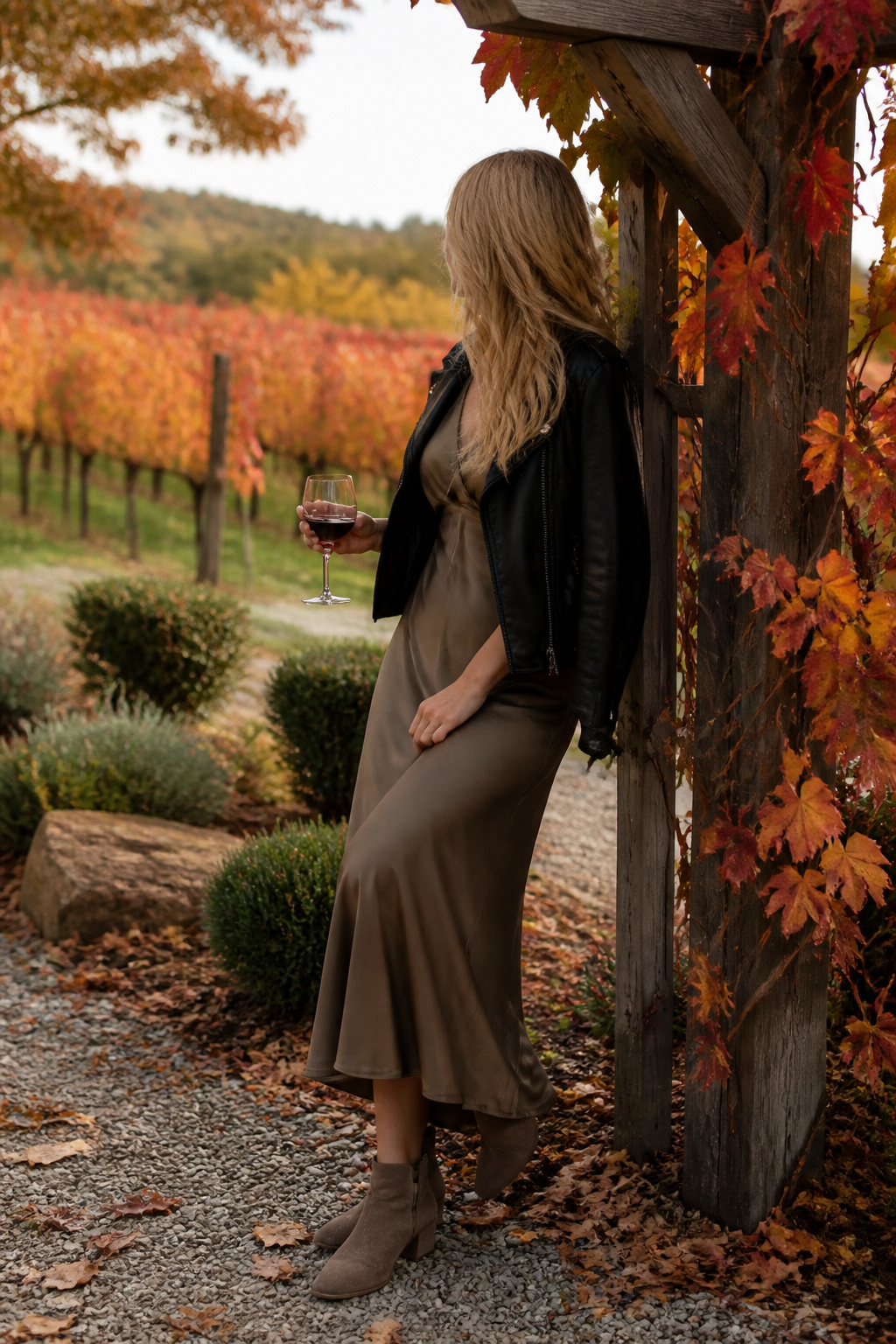
A slip dress with bold country-inspired abstract art paired with a leather bomber jacket is one of those combinations that sounds riskier than it wears. The dress does the talking; the bomber adds just enough edge to keep it from floating away. I have seen this work for a day tasting outdoors, then the jacket comes off for dinner inside and the whole tone shifts. The key is that one piece carries the outfit, not two competing for attention.
A plaid blazer over a simple black pocket dress operates on the same principle. The dress stays quiet so the blazer can be the statement, and the structure reads as intentional rather than loud.
Here is what took me longer to figure out: a vineyard in peak fall color is already doing half the work visually. A "statement" piece in that setting means shape and texture more than loud pattern. Abstract art on silk or a strong plaid reads as conversation because it contrasts with the landscape, not because it shouts over it. Two bold items at once, and you start to look dressed for a different event than the one happening around you. Rural settings forgive simplicity more readily than they forgive overperformance.
Casual Vineyard Tour Outfit
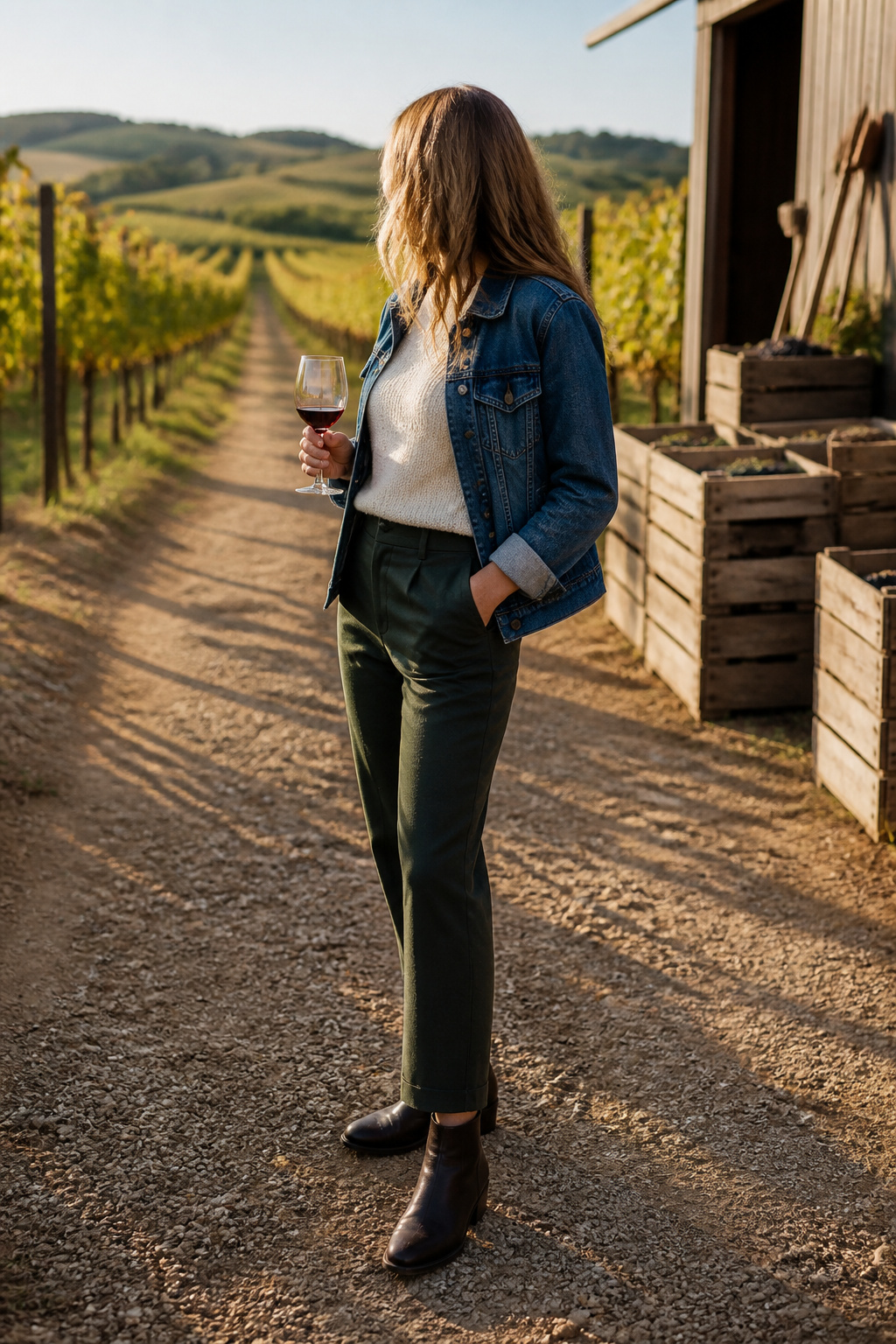
A vineyard tour is not a tasting room. The tasting room gives you a chair, a counter, and maybe twenty steps of polished concrete. A tour puts you on dirt paths between rows for two hours, standing while someone explains canopy management, then walking again. The outfit has to handle that, and the shoes matter more than anything else.
Sturdy ankle boots with a low heel are what you want here, not the kitten heel that works fine indoors. Marc Fisher makes an ankle boot that handles gravel without looking like hiking gear, and a cowboy boot is a solid option this fall if you want something on-trend. Flats or flat sandals can work on warmer days, but boots give you more protection against uneven ground and the dust that kicks up between rows.
The knit-and-trousers combination still applies, but the fabric choices shift. Tailored trousers keep their shape through the walking and standing, and a cozy knit gives you warmth that a thin layer won’t once the sun drops behind the vines. Bring a light jacket you can tie around your waist when the afternoon starts warm. A denim jacket or a leather jacket over that chunky sweater covers the temperature swing without making you carry a bag full of clothes you aren’t wearing.
Layering for Variable Weather
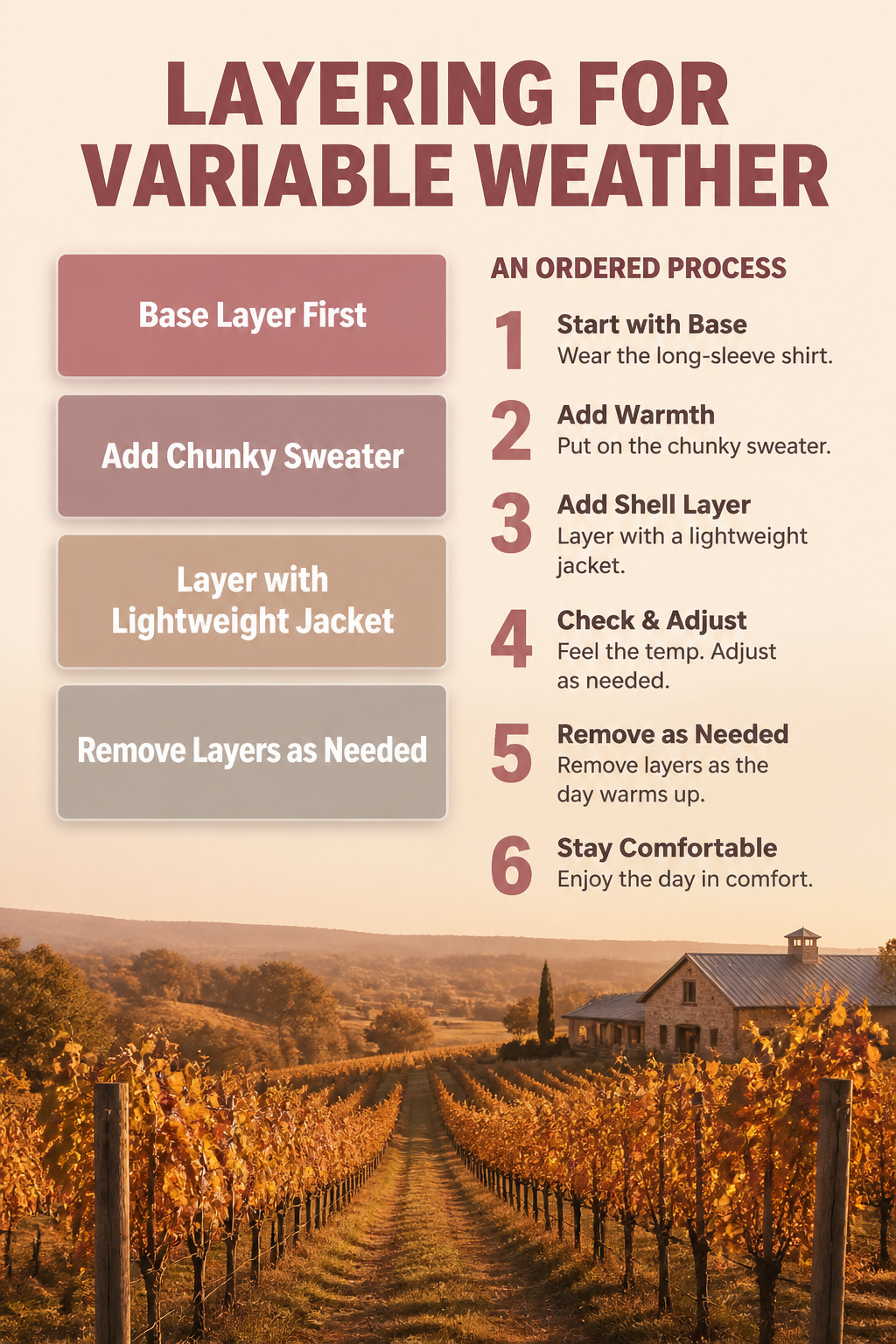
A long-sleeve shirt in a breathable fabric belongs against your skin, not because it looks interesting but because it buys you a ten-degree window you will use. I learned this the hard way at a hillside vineyard where the morning started at 52 and the tasting room hit 74 by noon. That base layer let me shed the chunky knit sweater without losing all coverage, which matters when the denim jacket comes off too and you are down to one piece.
The sweater itself is where the warmth lives. Chunky knits work for the brisk stretches between pours, especially if the winery sits at higher elevation where valleys feel mild by comparison. What does not work is piling on so many bulky layers that removing one leaves you in a heap. Aim for two pieces you can actually take off and carry, not three that fight each other for space under your arms.
A lightweight jacket, denim or leather, blocks wind without becoming its own problem indoors. The sequence matters: base, warmth, shell. Each layer needs to come off in under thirty seconds when the room overheats, because nobody wants to be the person sweating through a flight of whites while wrestling with a coat.
Footwear That Works
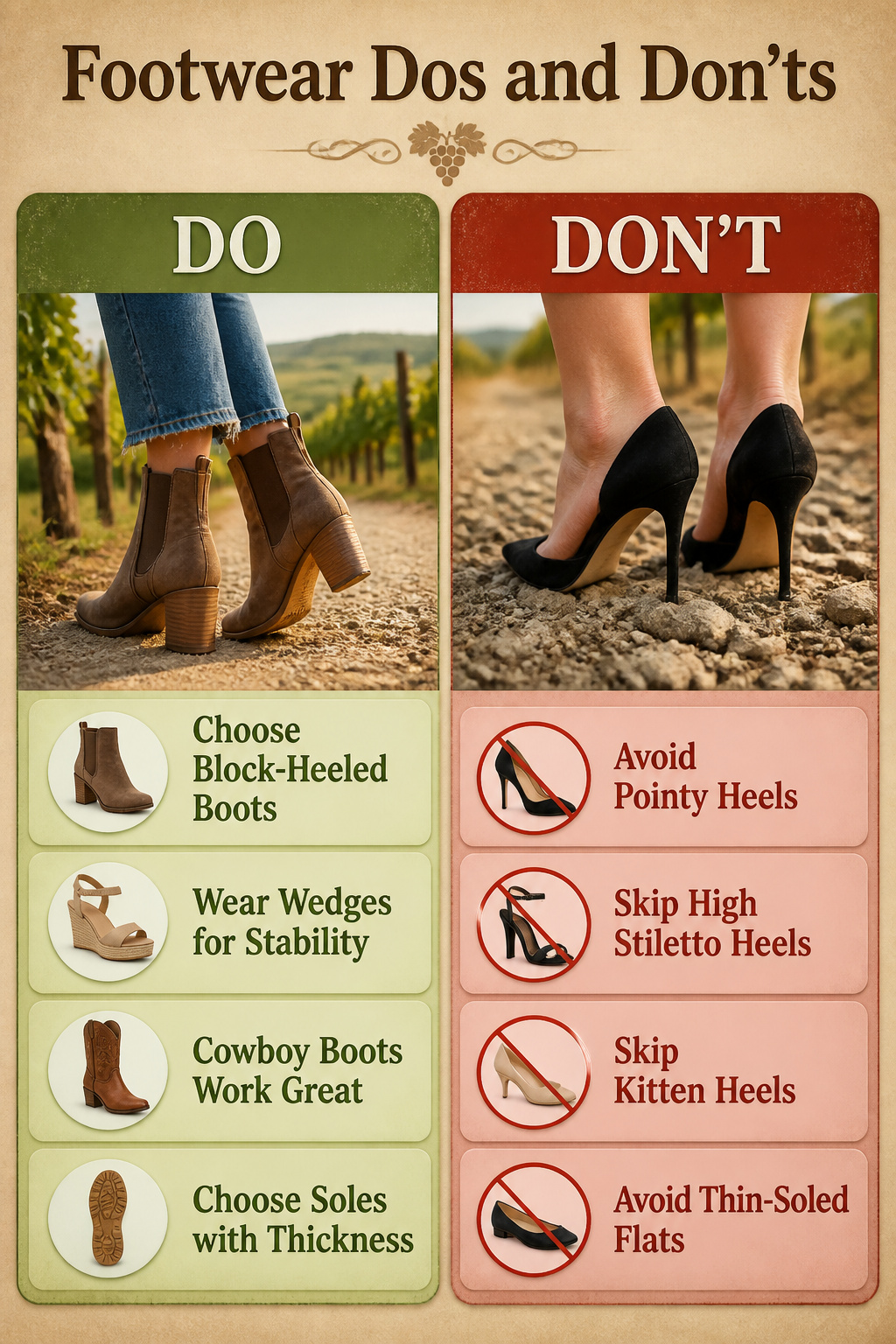
Crush pad gravel and grass are the two surfaces that ruin most fall winery outfits. A kitten heel will drive you crazy out there; even a low block heel sinks and wobbles on the loose stuff. I draw the line at about one and a half inches. Anything taller, and you are managing your shoes instead of tasting wine.
Cold concrete floors in the tasting room are the second problem. A sole with some thickness, not a ballet-flat slip, keeps your feet from aching after twenty minutes of standing. I learned that the hard way on a November trip where my thin-soled flats left me shifting weight like a penguin.
Block-heeled ankle boots are the fix I keep coming back to. They give just enough lift to feel dressed, but the heel is wide enough for gravel and short enough that a stumble is a catch, not a fall. Cowboy boots work if you want the current trend, and wedges are an option if you want height without the instability of a stiletto. Leave the pointy heels at home. No matter how cute they are, uneven terrain, wine, and thin air do not mix.
Color Choices for Fall Backdrops
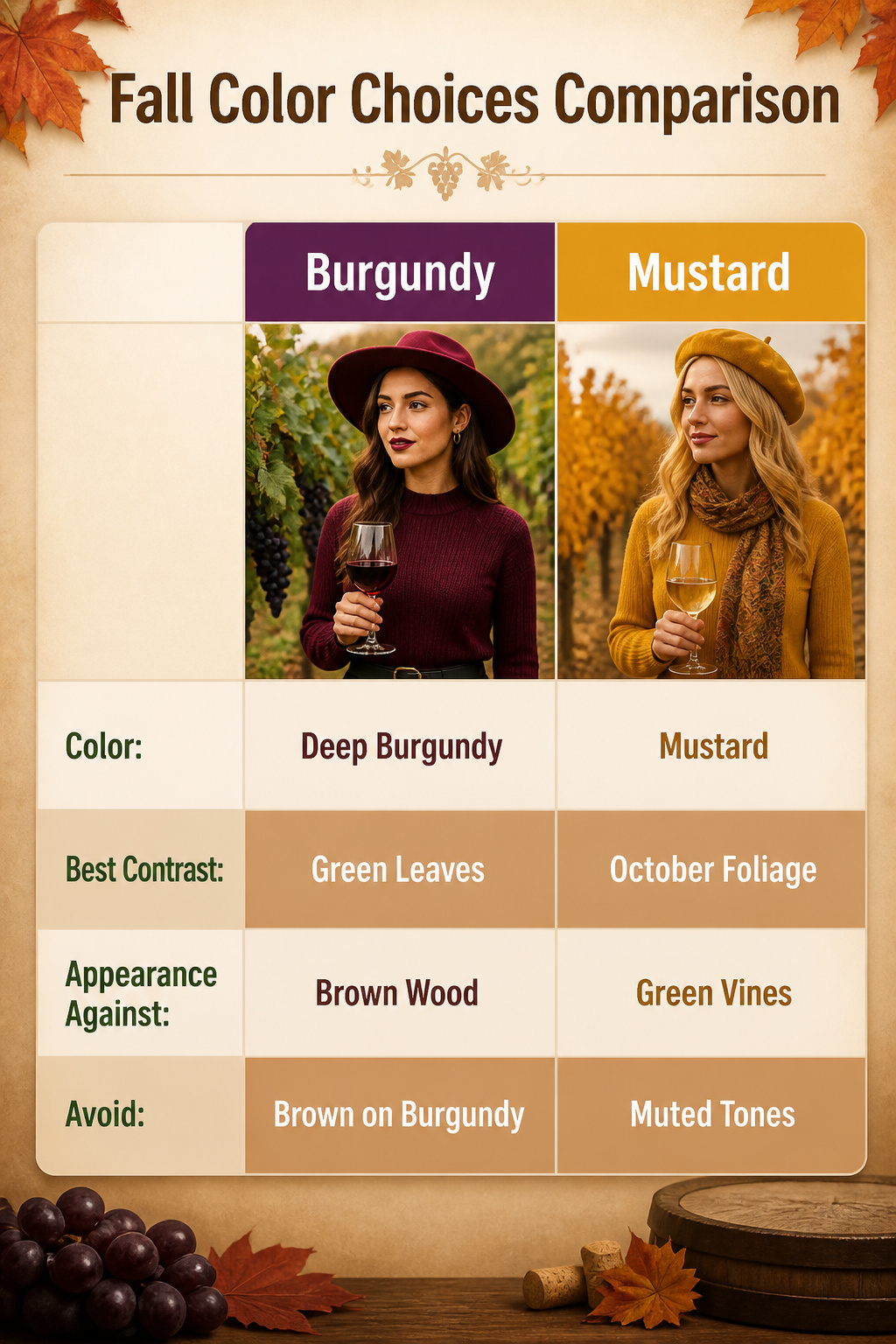
Olive green, burgundy, and mustard all read as fall winery outfits, but they behave differently once you are standing in front of the actual vines. Deep burgundy photographs elegantly against still-green September grape leaves; the contrast is sharp without being loud. Mustard and ochre come alive once the foliage turns, catching the last light on yellow October hills. Olive is the one that works almost everywhere, though against late-season brown it can go muddy and flat.
Brown is where I once made the mistake. A warm chocolate sweater and trousers seemed sophisticated in theory, but against the red barn at a Napa tasting room I disappeared completely. The photos looked like a floating head. A mid-tone brown needs either a green vine or a gray sky behind it, not competing wood.
The costume risk lives in matching too precisely. Burgundy dress, burgundy lipstick, burgundy wine glass in hand reads thematic in a way that feels assembled rather than worn. One source suggested bold lipstick as contrast, which works, but the simpler fix is separating the tones: a burgundy knit with olive trousers, or mustard accessories against a brown coat. Sophisticated fall winery outfits borrow from the setting without replicating it.
Comfort Without Looking Underdressed
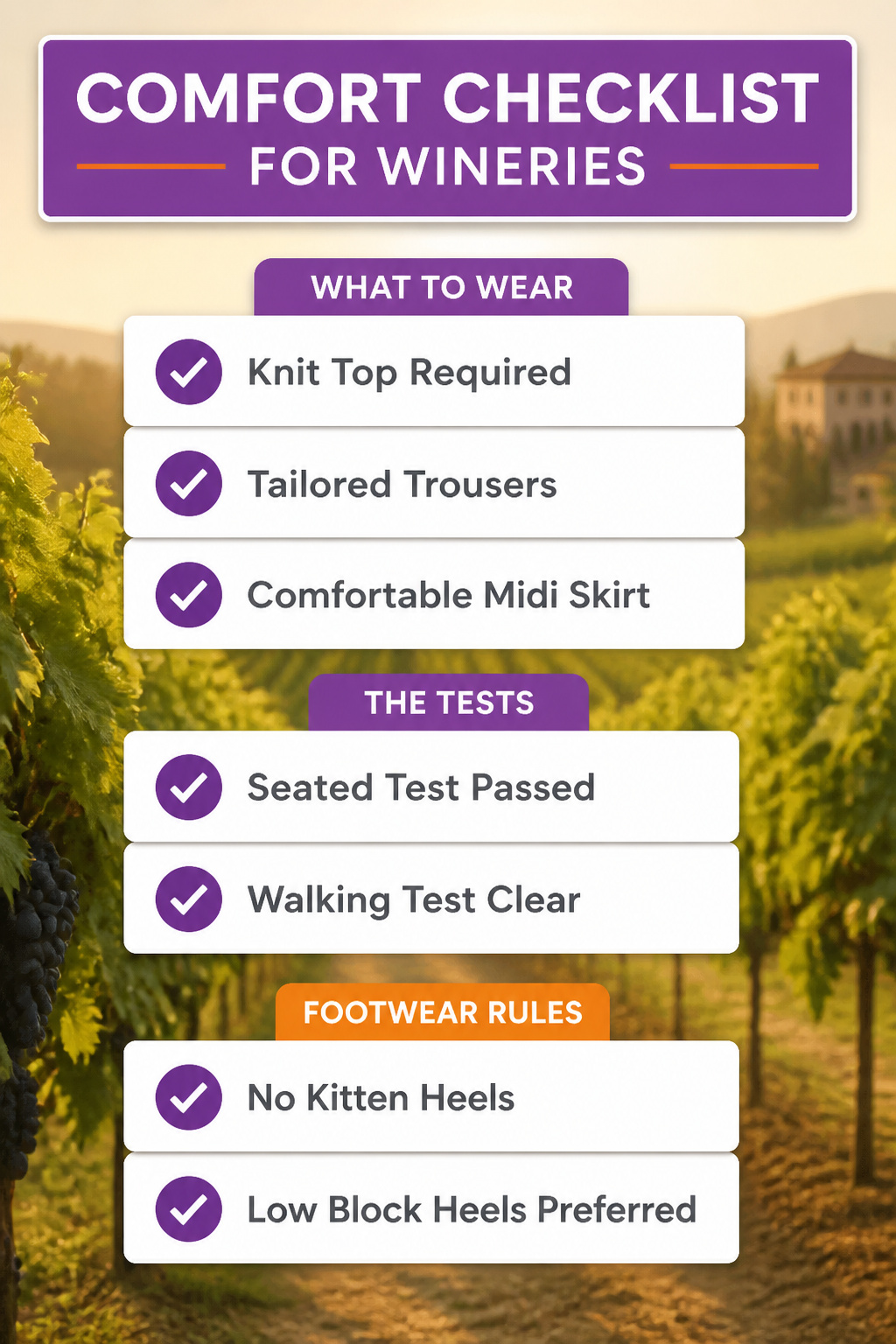
The phrase "wine country casual" sounds like permission to relax, but most wineries expect something sharper than vineyard workwear. What I look for is a midpoint: nothing that needs dry cleaning, nothing that looks like gym clothes. A knit top with tailored trousers or a midi skirt usually lands right.
The seated test and the walking test are what save me from an afternoon of regret. I sit on my kitchen floor for a full minute in the outfit, legs crossed, because barrel rooms and tasting patios use low benches and metal chairs. If the waistband digs or the skirt rides up, that outfit fails. Then I walk a quarter mile on my block, including a gravel stretch if I can find one. Anything that rubs, slips, or blisters in fifteen minutes will ruin the second tasting.
Heels are the obvious mistake, though sources split on how low is low enough. A kitten heel will drive you crazy on gravel, and even ankle boots need a block heel under two inches to stay stable. I wear my Margaux ballet flats or low-heeled booties and never think about my feet again.
Frequently Asked Questions
What should I wear to a winery in the fall?
Dress in layers, starting with a breathable long-sleeve base, adding a chunky knit for warmth, and topping with a denim or lightweight leather jacket. Choose earthy tones like burgundy, olive, or mustard that photograph well against grapevines and fall foliage. Finish with block-heeled ankle boots or cowboy boots that handle gravel and grass without wobbling.
Can I wear heels to a winery?
Avoid thin heels entirely; crush pad gravel and uneven grass between rows will sink or twist them with every step. The practical limit is about one and a half inches, and even then a block heel is necessary for stability. Cowboy boots, ankle booties with a low block heel, or flat-soled boots are what you actually want for walking between vines.
How do I layer outfits for variable fall winery weather?
Build in three pieces: a breathable long-sleeve base layer against your skin, a mid-weight or chunky knit sweater for warmth, and a lightweight denim or leather jacket as a wind-blocking shell. Each layer needs to come off in under thirty seconds when the tasting room overheats, because morning temperatures in the fifties can climb to the seventies by noon. Limit yourself to two layers you can actually carry, not three bulky pieces that fight for space under your arms.
What colors should I wear to a winery in the fall?
Deep burgundy photographs sharply against green September leaves; mustard and ochre catch the light once October hills turn yellow. Olive works almost everywhere, though it can go flat against late-season brown. Avoid matching too precisely to the setting, like head-to-toe burgundy with a wine glass in hand, which reads assembled rather than worn. Mid-tone brown needs a green vine or gray sky behind it, not competing red barn wood, or you risk disappearing entirely in photos.