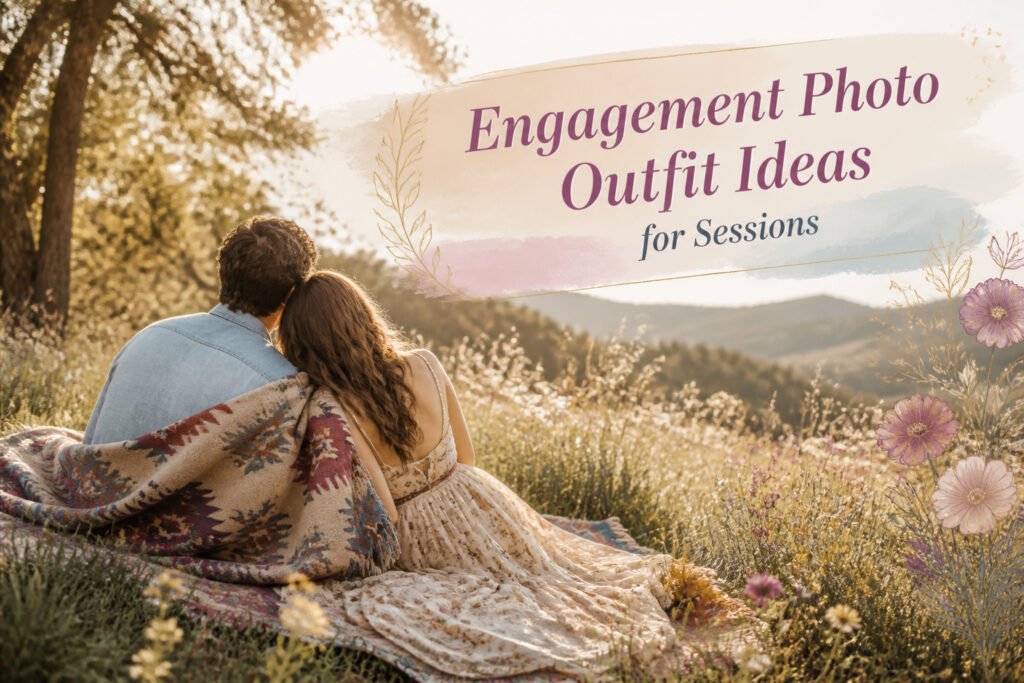
The right engagement photo outfits ideas range from a $20 thrifted Pendleton blanket to a rented formal gown, and the deciding factor is not style but whether you will touch the hem or strap more than twice. Wind lifts chiffon and silk into shape; heavy gowns drop like curtains and read as furniture in outdoor light.
1. Flowy Dresses That Move

A dress that moves gives the photographer something to work with beyond two people standing still. Fabric catching wind creates shape where the body stays relaxed, and the resulting shots look intentional without feeling posed.
Chiffon and silk do this best. Both fabrics hold a line when they lift, then settle again without the stiff crumple of heavier material. Cotton and linen work too, especially in summer heat, though they billow differently, more softly.
The mistake is picking something with too much structure. A heavy gown or a fully lined cocktail dress looks beautiful on the hanger, but it takes real wind to lift it, and even then it drops like a curtain. I have seen sessions where the dress technically moved but photographed as a solid block of color, defeating the whole point. A dress too heavy to lift reads as furniture in outdoor light.
Dresses with slits add another kind of motion, the fabric parting as you walk or sit, which breaks up a long expanse of material without needing wind at all. The goal is the same: give the camera something alive to catch.
2. Earth Tones for Natural Settings

Rust, olive, cream, and terracotta share one quality that makes them reliable for outdoor engagement sessions: they already exist in most natural settings. A rust sweater picks up the dried leaf on the path behind you. Cream mirrors the light sky rather than absorbing it. These colors do not announce themselves as "outfits against nature." They settle into it.
The real advantage is how they handle shifting light. Golden hour moves fast, and a color that reads vivid at 5:15 can turn flat by 5:40. Earth tones shift gradually with the sun instead of falling off a cliff. A burgundy dress I once chose for a late-afternoon session turned to muddy brown the moment we stepped into tree shade, and the photographer’s correction only made the fabric look dusty. Rust would have held its warmth. Terracotta would have simply deepened.
Olive works harder than it gets credit for. It flatters most skin tones, and against green foliage it creates depth without the "floating head" effect of pure neutrals. Cream keeps the image from going too heavy, especially if your partner wears the deeper tone. The balance is intentional without looking arranged.
3. Casual Outfits That Still Read as Intentional

Dark-wash denim anchors the look without drifting into Saturday errand territory. A fitted knit, something with a little weight to it, reads as chosen rather than grabbed from the dresser in the dark. Clean sneakers or loafers finish it; the line stays low and unforced.
The jaw relaxes when the outfit does. I learned this watching my own engagement proofs years ago. My sweater was fine, but the trousers I insisted on were stiff and new, and I can pick out the frames where I was conscious of them with every step. Shoulders ride higher, the chin juts slightly to compensate. The camera catches it.
A simple cotton crewneck in a tone that flatters your skin, paired with jeans that have lived through a few washes and shoes you have actually walked in, will outperform something borrowed or bought the week before. The knit should skim, not cling; the denim should hold its shape without trying too hard. Leave the tags-on pieces for another occasion.
4. One Formal Look to Elevate the Session
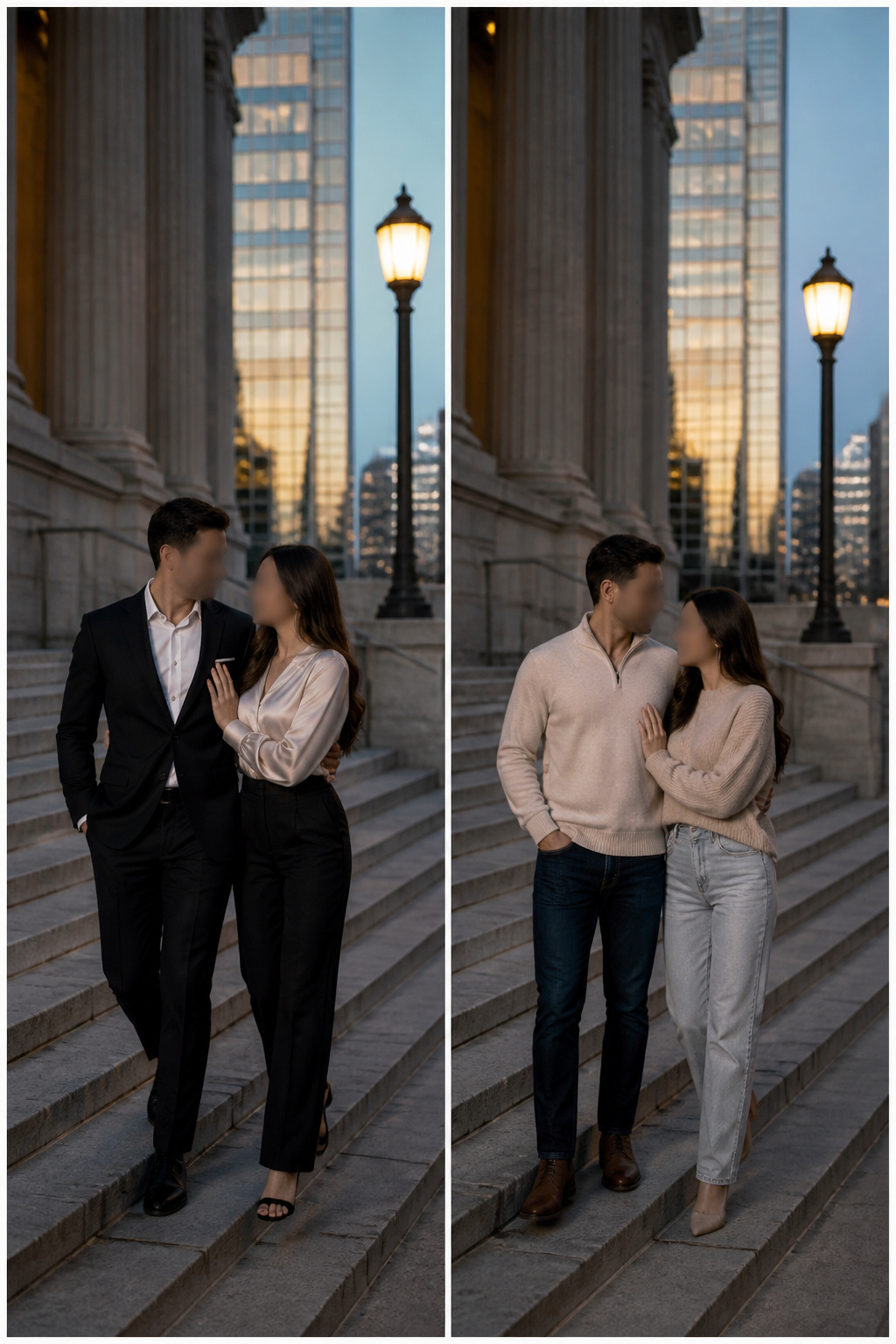
A second look that reads dressier than your daily clothes keeps the gallery from flattening into one mood. Evening light against city glass, or a granite courthouse stair, asks for something sharper than jeans and a sweater. One partner in a structured dress or a real suit carries the formality; the other stays a half-step softer, maybe a silk blouse with trousers or a knit under the blazer, so the pair reads like adults going somewhere special rather than two people headed to prom. I like the idea of renting this single-use piece through Rent the Runway, returning it after the shoot instead of letting a $400 dress haunt the closet unworn. The swap takes five minutes in a parking lot if you plan the order: casual first while you are still warming to the camera, then the dressed-up set once your posture has loosened. Two outfits, two temperatures of photograph, and nothing bought that you will not wear again.
5. Layers for Variety Without a Full Change

A tailored blazer or a soft cardigan tossed over a simple base can turn one outfit into two or three distinct looks in about 90 seconds, which matters when the light is fading and your photographer is watching the clock. A full outfit change in a location with no real changing facilities usually runs closer to 15 minutes of shuffling in and out of the car, adjusting undergarments, and hoping the grass stains stay off the white pants.
The base layer should be something you are happy to be photographed in on its own: a clean tank tucked into jeans works, or a fitted knit dress if the weather cooperates. From there, a structured jacket gives you polish for the first set of frames, and removing it shifts the same pieces into something more relaxed for the next. A scarf adds pattern without the risk of a graphic tee fighting the camera; drape it, knot it, or let it disappear entirely. The pockets stay empty either way. Keys and phones show through in ways you will notice later and resent.
6. Accessories That Add Personality

A wide-brimmed hat or a pair of Ray-Bans can add the dimension photographers call "the third item," but borrowed props read as borrowed on camera. My own rule is one focal accessory per person; two competing statements fight for attention and neither lands. Statement earrings work if they stay within that single-slot budget. A watch can ground a look, though an Apple Watch usually breaks the spell unless the outfit is deliberately casual. Small props, a book you actually read or the bike you ride on weekends, do more than fill hands. They give you something to do, which matters more than most couples expect. The Pendleton blanket you thrifted beats the generic sign every time. What you bring should already live in your life, not arrive for the photo and leave with it.
7. Why Heavy Patterns Fight the Camera

Small repeating patterns are the real troublemakers in engagement photos. Thin stripes, tight checks, and dense florals can trigger moiré on digital sensors, that wavy distortion where lines seem to vibrate and blur together. Large-scale prints behave better because the camera can actually resolve them, but busy prints of any size still pull the eye away from where it belongs: your faces.
Solid colors or subtle textures photograph cleaner and keep the focus on the connection between you two. After sitting with this advice across dozens of sessions, the exception that consistently works is one quiet stripe paired with a solid partner. The slight rhythm breaks up visual monotony without starting a competition for attention. Two patterns, though, and the clothes become the subject.
8. Seasonal Fabric and Color Choices

Linen and pastels read spring in engagement photos the way nothing else does. The fabric catches light instead of reflecting it back harsh, and a soft blush or sage keeps the couple from looking like they wandered into a garden catalog. I learned the hard way that bare shoulders in November look exactly as out of place as a turtleneck in July, regardless of how much someone loves their off-the-shoulder top or that cashmere rollneck they impulse-bought.
Summer calls for breathable cotton and brighter tones that won’t show sweat during the movement these sessions usually involve. A cotton or silk dress paired with a simple linen shirt on your partner keeps the heat manageable without falling into vacation-mode casual.
Fall engagement photos already compete with foliage color, so neutrals like navy, cream, or tan let the leaves do the heavy lifting while olive or rust knits add warmth without shouting. Light wool layers well and photographs with subtle texture.
Winter demands deep jewel tones and deliberate texture, think velvet or a heavier knit, because flat color disappears against gray skies and bare branches. The season gives you permission to go richer and more saturated than you might instinctively choose.
9. Coordinating Without Matching Exactly

The 60-30-10 rule gives two people a shared language without looking like twins. 60% of the frame stays in one tone (sand, olive, slate, whatever ground you choose), 30% shifts to each person’s individual value (a deeper version of that tone for one, a lighter wash for the other), and the last 10% becomes the single accent that ties them together. A blush dress and a navy coat with a blush pocket square, for instance, or mustard earrings against a blue shirt.
Same color family, different values. That means one of you might wear a soft blue chunky necklace while the other wears navy, not because blue is "the theme" but because those values sit near each other on the same strip of paint chips. Or one neutral plus one color: khaki or gray pants against a color that actually shows up in the other person’s outfit.
The mistake is wearing identical colors in identical saturation. Two blush tops, two navy bottoms, same brown shoes. The camera flattens that into one blob. Vary the formula too: jeans and a tee on one side, a casual dress or linen pant on the other. Layers help. A jacket or vest breaks up the silhouette so the eye reads two people, not a matched set.
10. Shoes You Can Actually Walk In

Block heels or flats are the only sensible call for grass, gravel, or cobblestone. A photographer I work with once watched a client sink three inches into a lawn in stilettos, then lose twenty minutes to recovery while her heels collected mud and her mood flatlined. Bring the walking pair and change at the spot if you want the dress-shoe look for city pavement; clean boots handle trails without the bulk of full hiking gear, and a backpack buys you both the photo and the walk there. Nothing in the frame reads as romantic when you are wincing.
How Many Outfits to Actually Bring

Two outfits is the practical maximum for most engagement sessions, and even that only works if the location has a private place to change. One outfit with a layer swap, like adding a blazer over a dress or switching a sweater for a button-down under the same coat, photographs as two distinct looks without the time sink of a full change.
The pressure is real. Every minute spent deciding between the third option or hunting for a lost earring is a minute you are not in front of the camera, and decision fatigue shows in shoulders and in smiles. Most photographers plan an hour of shooting time; two outfits with a layer change fills that cleanly, while three starts to cannibalize the warm-up minutes where you are still finding your rhythm together.
I used to pack three options for any shoot, thinking variety meant value. The galleries that came back proved otherwise: the best frames clustered in the first forty minutes, before the mental load of the next change crept in. Now I bring one casual look and one more formal look, or one base outfit with a layer that transforms it. The camera sees the difference; your schedule does not bleed.
Comfort Shows on Camera

Stiff shoulders and a tight smile are what the camera sees when the outfit is doing the talking instead of you. I notice it most in the jaw, a held tension that drops the moment someone changes into the jeans they actually live in. The shoulders relax half an inch. The posture opens. That is the version of you that photographs.
Most couples bring two looks, one casual and one more formal, and starting with the easy outfit makes sense for exactly this reason. The body warms up when the clothes do not demand attention. Flowy dresses and skirts move well on camera, but so does a graphic tee you have worn a hundred times if that is who you are. A ball gown on a cliff works only when it feels like your idea, not a costume you are performing.
The physical tells to watch for are specific: raised shoulders that do not drop between shots, a frozen half-smile that does not reach the eyes, weight held back on the heels as if ready to retreat. These are not expressions you can correct by trying harder. They are signals that something in the outfit is asking you to be someone else for an hour.
Comfort reads as confidence because it removes the self-conscious layer between you and the lens. Shoes matter here too. Six-inch heels carried in a backpack for the posed shots, with hiking boots for the walk in, keep the body loose when it counts. Restriction anywhere, a waistband, a collar, a shoe that pinches, becomes the story the photograph tells.
What to Skip Entirely

A neon pink blouse that looked electric in the mirror will fight the camera for attention and usually lose. The same goes for any top, pant, or accessory plastered with a visible logo. Logos and neon colors read as visual noise in engagement photos, pulling the eye exactly where it should not go.
Flip-flops are another momentum killer. Even the dressiest pair forces you to shuffle, grip with your toes, or stop entirely when the path turns uneven. One photographer I spoke with while researching this keeps a "no casual flip-flops" rule for clients because the adjustment breaks kill the flow of a session faster than almost anything else.
Anything requiring constant adjustment belongs in the same skip pile: straps that slip, waistbands that roll, hemlines that ride. If you touch it more than twice while trying it on, you will touch it forty times in front of the camera. Apple watches look blocky and date images; bulky scarves or heavy layers near the face compete with expression. One session I observed had a couple in otherwise perfect outfits, but the woman’s turtleneck kept bunching at the jawline. They have maybe three usable frames from an hour of shooting.
The practical test is motion. Walk in the outfit. Sit, stand, lean together. If your hands find a hem or a strap, swap the piece.
Where to Shop Without Overspending

J.Crew and Anthropologie keep coming up in these sessions for a reason: their pieces still look right five years later, which means the resale market actually wants them back. A cashmere sweater or tailored blazer bought for engagement photos can fund its own replacement on Poshmark once the session is done. Rent the Runway is the smarter move for anything you will truly wear once; a formal gown or statement suit that photographs beautifully but has no second life in your closet belongs there, not in your wardrobe budget.
The mistake is buying for the trend cycle instead of your body and the occasion. That quiet-luxury cashmere reads timeless on camera because it drapes the way it is supposed to, not because the label is having a moment. Same with the Western romance pieces at Anthropologie: the suede and denim work when the cut suits you, not when the aesthetic is trending. Rent the runway for the fantasy outfit you cannot justify owning, buy the piece that already fits into your life.
Props That Mean Something

A borrowed guitar sits wrong against your body, and the camera catches the hesitation in your shoulders before you even try to strum. That is why the best engagement photo props are the ones already in your daily life. Your dog, the instrument you actually practiced on, the novel with the cracked spine from rereading: these read as part of you because they are.
The test is whether you would reach for it on an ordinary good Saturday. If you would not, leave it home. A friend lent me her vintage bicycle once for a shoot, and in every frame my hands hovered like I was afraid to grip the handles. The camera sees borrowed props as performance, not personality.
If you play, bring the ukulele with the dent from your coffee table. If you read together, tuck that specific paperback in your jacket pocket. Let the photographer catch you mid-laugh explaining the plot, not posing with a prop you had to be reminded to hold.
Frequently Asked Questions
How many outfits should we wear for engagement photos?
Two outfits is the practical maximum for most sessions, and even that only works if you have a private place to change. One outfit with a layer swap photographs as two distinct looks without the time sink of a full change. Most photographers plan an hour of shooting time, and decision fatigue shows in shoulders and smiles, so the best frames usually cluster in the first forty minutes.
What colors should we wear for engagement photos?
Earth tones like rust, olive, cream, and terracotta settle into natural settings rather than fighting them. These colors shift gradually with the sun instead of falling flat when the light changes. If you want a brighter touch, keep it to one subtle pop against a neutral palette so the eye stays on your faces, not the clothing.
Can we wear patterns for engagement photos?
Small repeating patterns are the real troublemakers, thin stripes, tight checks, and dense florals can trigger moiré distortion on digital sensors. Large-scale prints behave better because the camera can actually resolve them, but solid colors or subtle textures photograph cleaner and keep the focus where it belongs. One quiet stripe paired with a solid partner is the consistent exception that works.
What should we avoid wearing for engagement photos?
Skip neon colors, visible logos, flip-flops, and anything requiring constant adjustment like slipping straps or rolling waistbands. Apple Watches look blocky and date images, bulky scarves near the face compete with expression, and stiff new pieces show in raised shoulders and held jaws. If you touch it more than twice while trying it on, you will touch it forty times in front of the camera.
What type of shoes should we wear for engagement photos?
Block heels or flats are the only sensible call for grass, gravel, or cobblestone. Bring the walking pair and change at the spot if you want dress shoes for city pavement. Clean boots handle trails without the bulk of full hiking gear. Nothing in the frame reads as romantic when you are wincing, and a photographer can spot the hesitation in every step.